generic-NAS, solid rivet
MS20470 solid rivet
MS20470 / MS20426 solid rivet: universal and 100-degree countersunk heads, driven from both sides.
- Shear 28-53 ksi
- Access Two-sided
- Diameters 0.0625 to 3/8"
- Materials Aluminum, Titanium
- Lead-time risk Low
Head style
Range source
MS20470 p.3 · dash number and LENGTH tables (sheets 3-5). Bands use published limits; gaps remain visible. The near-edge check is SpecLok’s 20% threshold.
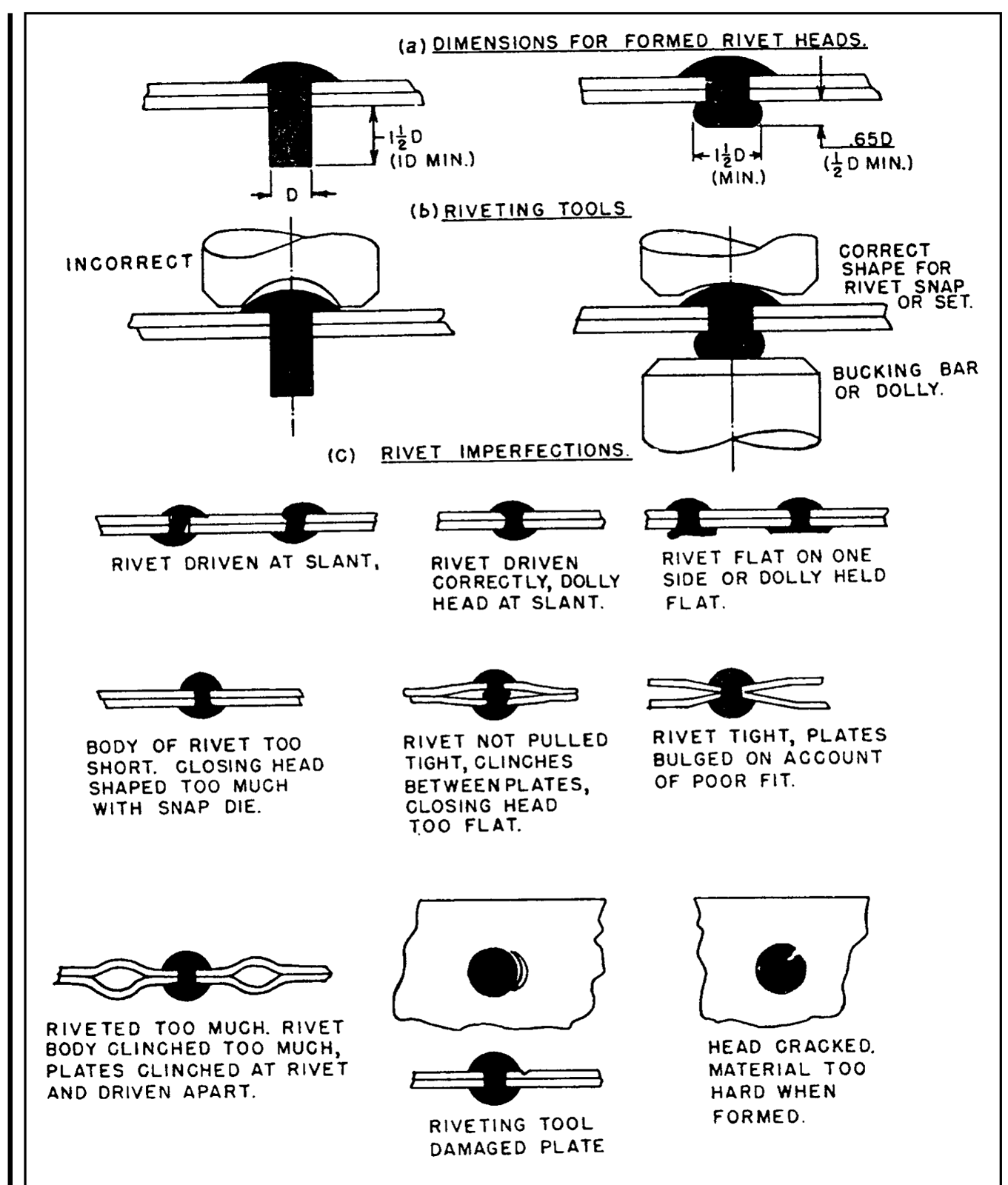
Two-sided, solid rivet: “CORRECT SHAPE FOR RIVET SNAP OR SET. BUCKING BAR OR DOLLY.” (FAA AC 43.13-1B, p.4-21, Figure 4-6 (b) Riveting tools)
- Shear
- 28-53 ksi
- Blind bulb
- n/a
- Install
- Both sides needed
- Diameters
- 0.0625, 3/32, 1/8, 5/32, 3/16, 0.21875, 1/4, 5/16, 3/8"
- Lead-time risk (SpecLok assessment)
- Low
Typical applications
- ·Metal structure with access to both sides (AC 43.13-1B)
Strengths
- +Standard part (MS20470 / MS20426; AC 43.13-1B para 4-57)
- +Driven shear strengths published in MIL-HDBK-5J Table 8.1.2(b)
Trade-offs
- −Requires access to BOTH sides (bucking)
- −Not for composite: laminates can't support formed-fastener installation stresses (MIL-HDBK-17-3F §6.3.3.3)
- −Lower strength than blind bolts and pin-and-collar (MIL-HDBK-5J Table 8.1.2(b))
Also called AN470, universal head rivet, solid rivet. P/N: MS20470 / AN470 · e.g. MS20470AD4-5
Dimensions
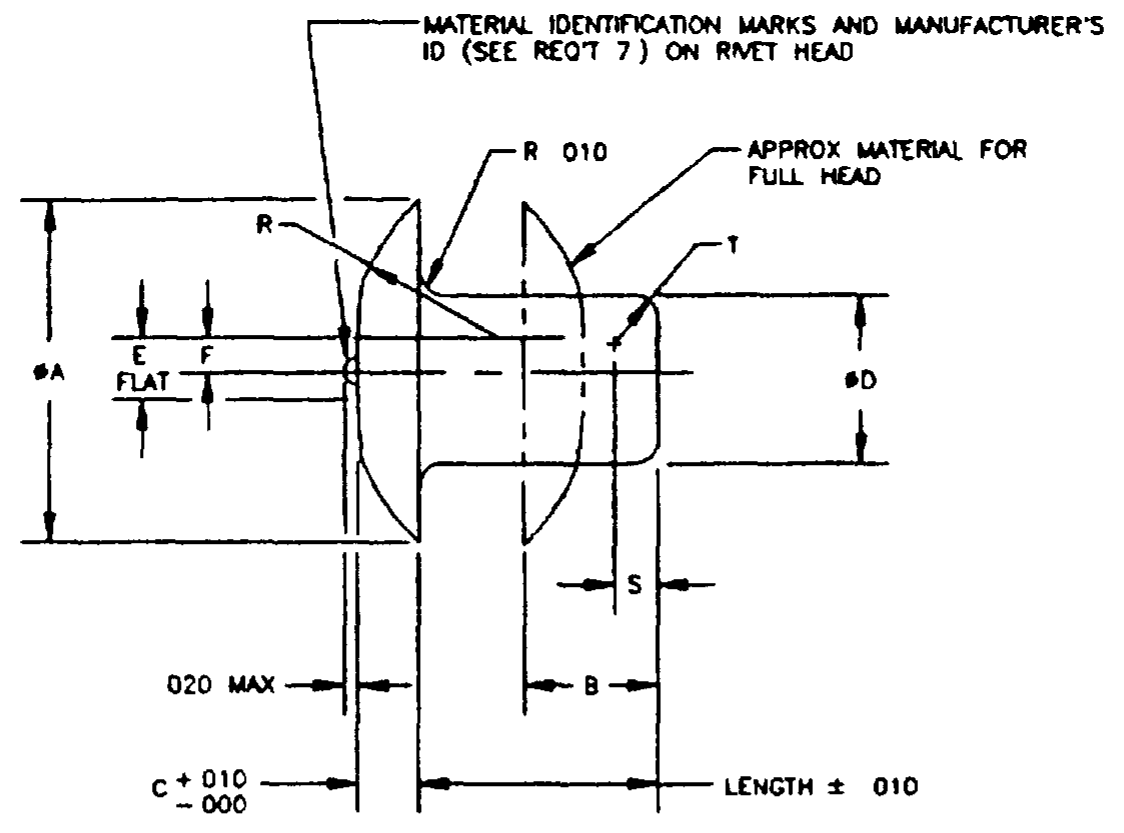
| LENGTH | Dash 6-7 | .438± .010 |
| ØD | Shank diameter | .1871/ |
| ØA | Head diameter at the bearing face | .375± .019 |
| C | Head height | .080+.010 -.000 |
| Stack | Derived: LENGTH - B to LENGTH - D (not printed) | .157-.251 |
All dimensions (12)Fewer dimensions
| B | Approx material for a full driven head (shank past the work) | .281 |
| E | Flat on the head top (diameter) | .093 |
| F | Crown radius centre, off the axis | .046 |
| R | Crown radius (drawn derived from A, C and F) | .164 |
| S | Optional end chamfer length (not modelled) | .047 |
| T RAD | Optional end radius (not modelled) | .059 |
| R | Head-to-shank radius (figure) | .010± .010 (note 1) |
As printed on MS20470 p.1 ↗. Letters match the drawing.
Printed in MS20470 for MS20470A6-7
| RIVET material | ALUMINUM 1100-F (A91100) PER QQ-A-430; finish: FOR 1100 AL CHEMICAL SURFACE TERATMENT PER MIL-C-5541 CLASS 1A, GOLD/YELLOW (NO CODE) (MS20470 p.2 requirement 2 and requirement 5) |
|---|---|
| Length | .438 in ± .010 (dash 6-7) (MS20470 p.4) |
| Material for a full driven head | B .281 in (APPROX MATERIAL FOR FULL HEAD) (MS20470 p.1 Table I) |
| Stack range (derived) | .157 to .251 in: LENGTH - B to LENGTH - D (1 D min protrusion, FAA AC 43.13-1B CHG 1 Figure 4-6(a) DIMENSIONS FOR FORMED RIVET HEADS (page 4-21)); not printed in MS20470 (derived) |
| End forms | RIVETS MAY BE FURNISHED WITH PLAIN ENDS, OR ENDS CHAMFERED UP TO 20° TO THE "S" DIMENSION OR MAY HAVE A RADIUS TO THE "T" DIMENSION (MS20470 p.2 requirement 1) |
| Driven head (installed model) | 1-1/2 D diameter, .65 D high (minimums 1-1/2 D and 1/2 D): FAA AC 43.13-1B CHG 1 Figure 4-6(a) DIMENSIONS FOR FORMED RIVET HEADS (page 4-21). Guidance, not an MS20470 dimension. (not MS20470) |
Datasheet strength: As-driven Fsu: AD (2117) 30 ksi, B (5056) 28, D (2017) 38, DD (2024) 41 ksi: MMPDS-02 Table 8.1.2(b), reproduced in Cherry CA-1032.
Materials and galvanic compatibility vs CFRP
| Alloy | Shear (ksi) | vs CFRP | Notes | Source |
|---|---|---|---|---|
| Aluminum | 30 | high | AD (2117-T3); also B 5056 (28), D 2017 (38), DD 2024 (41), E 7050 (43) | MIL-HDBK-5J Table 8.1.2(b) driven Fsu; 7050 per MMPDS-02 via CA-1032 |
| Titanium | 53 | low | T (45Cb titanium-columbium) | MMPDS-02 Table 8.1.2(b), reproduced in Cherry CA-1032 |
vs CFRP: MIL-STD-889C Table I, graphite column: high = incompatible in marine atmosphere, sea water and industrial atmosphere; med = incompatible in marine atmosphere and sea water, compatible in industrial atmosphere (brass); low = compatible except sea water; unrated = not a Table I entry (non-metallic).About derived ksi
Specs source: MS20470H spec sheet + MIL-HDBK-5J Table 8.1.2(b) ↗: MS20470H Table I: sizes 1/16"-3/8", material codes; MIL-HDBK-5J p.8-13 driven shear strength. Lead-time risk is SpecLok's sourcing assessment, not a datasheet value.
Section from MS20470 REV H, 14 SEP 93 (supersedes MS20470G, 28 JAN 91) ↗ p.1.Drawing notes
Model
Envelope model, not manufacturer CAD. Download STEP or STL from the part panel at the top.Model details
MS20470A6-7, manufacturer nominal. Simplified component model from MS20470 REV H, 14 SEP 93 (supersedes MS20470G, 28 JAN 91): one named solid per physical part (RIVET), printed dimensions as printed. The crown radius is derived from A, C and F. Plain end; head marks not modelled. Not manufacturer CAD. Verify against the current document before use. Axis +Z, head up, z = 0 at the face the head bears on. STEP (AP214) is in inches; STL in millimetres.
Source
- MS20470 REV H, 14 SEP 93 (supersedes MS20470G, 28 JAN 91) ↗ RIVET, SOLID UNIVERSAL HEAD, ALUMINUM ALLOY AND TITANIUM COLUMBIUM ALLOY.
- RIVET: ALUMINUM 1100-F (A91100) PER QQ-A-430; finish: FOR 1100 AL CHEMICAL SURFACE TERATMENT PER MIL-C-5541 CLASS 1A, GOLD/YELLOW (NO CODE).
- Numbering: MS20470 AD 4 - 12 A -5 = ALUMINUM ALLOY 2117-T4 RIVET, 1/8 DIA, (3/4 + 1/32) LONG, ANODIZE CLEAR (MS20470 p.2). Finish and option codes are not chosen here. No part number pages for this family yet: the configurator only.
- Each physical part is its own solid, named as the document names it. What the document draws without a dimension is left out or, where the shape is needed, scaled from its figure (or taken from cited guidance) and labelled; see the drawing notes and the STEP header.
- Every head style, rivet number, diameter and grip on the transcribed standards pages. The 3D view, the drawing and the STEP / STL download are all built from the printed dimension letters; nothing the catalog does not dimension is modelled.
MS20470 p.1-1, manufacturer printed values.
Printed as is: 4 values in MS20470 that look inconsistent
- p.5 3/8 NOM DIA block: The 3/8 block is headed "3/18 NOM DIA", and its 1.500 row prints "A10-24" in the 1100-F column (every other cell in the block is 12-, e.g. "AD12-24").
- p.4 3/16 NOM DIA block: The 3/16 -3 length (AD6-3 only) is printed "187"; the -3 rows of the other blocks print "188".
- p.2 requirement 5: The finish note for 1100 aluminum is printed "CHEMICAL SURFACE TERATMENT" (kept as printed).
- p.1 TABLE I: F is half of E to the printed thousandth on every row (E .031, F .015 at 1/16); the crown radius centre sits F off the axis, so the arc meets the head top at r = F, which is the edge of the E flat.
2 head styles
Not redrawn: no head dimensions for this variant in the documents on file. The data at right is from the cited document.
Universal head
- MS20470: Material code letter, e.g. AD = 2117-T aluminum alloy (AN470 superseded by MS20470)MS20470H spec sheet, Table I ↗
Source: FAA AC 43.13-1B, para 4-57a(4) ↗
Head styles (manufacturer terms)
- Universal head (MS20470)
- 100-degree countersunk head (MS20426)
Solid · 3 steps
1/3Shank protrudes
“1½D (1D MIN.)”
FAA AC 43.13-1B, p.4-21, Figure 4-6 (a) Dimensions for formed rivet heads ↗
Drawing traced from: (a), before driving.
Source images (4): patent and government drawings
A patent drawing shows the patented design, which can differ in detail from today's catalog part. Each image says why it is tied to this family.
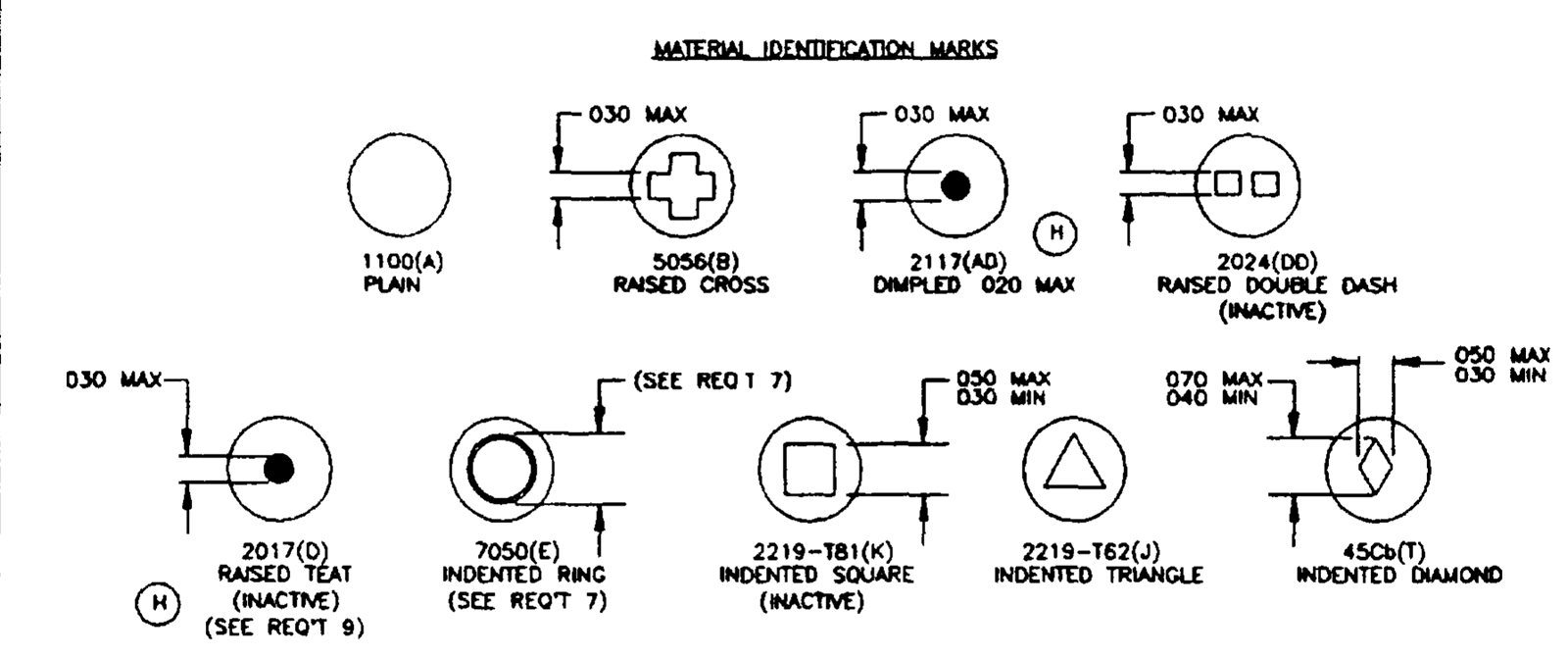
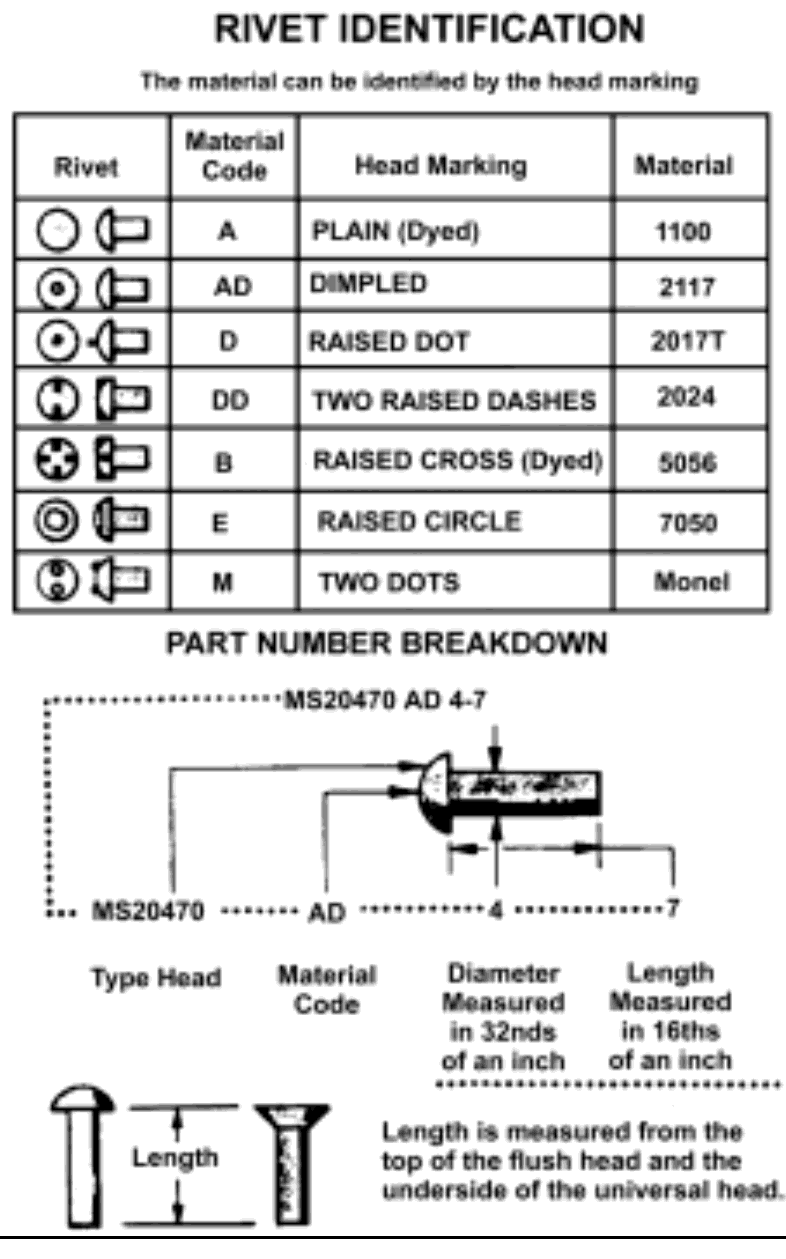
Official manufacturer install demonstration: MS20470 solid rivet installation.
Installation verification and preload
Installed preload
Not applicable: driven solid rivets are not preload-controlled fasteners (AC 43.13-1B).
What to check after install
- Shank protrusion before driving: 1.5D nominal (1D minimum).
- Driven (shop) head: diameter 1.5D minimum; height 0.65D nominal (0.5D minimum) (AC 43.13-1B Fig 4-6(a)).
- Reject per the Fig 4-6(c) defect chart: slanted rivet or bucking bar, flat-sided head, too-short body, rivet clinched between plates, bulged plates, over-driven head, tool-damaged plate, cracked head.
Check gauges (1) and sources.Details
- Driven-head dimensions measured directly (scale/calipers); rivet gauges are shop-made or commercial 1.5D/0.5D go-gauges.
Sources: FAA AC 43.13-1B, para 4-57 / Fig 4-6. Acceptance limits belong to the controlling spec; verify against your program's process documentation.
- Tool
- Rivet gun and bucking bar
- Special / proprietary
- Standard tooling
- Training
- Not stated in the cited documents.
- Inspection
- Driven head dimensions per AC 43.13-1B Fig. 4-6.
Driven head min 1.5D diameter and 0.5D height, 0.65D nominal (AC 43.13-1B Fig. 4-6(a)). MIL-HDBK-17-3F §6.3.1: special composite fasteners "eliminated the use of rivets" in composite.
The published install tool and nose for each size, other access options, and the gauges that check the install, from the manufacturer's own tool tables.
Tool: Rivet gun and bucking bar
Rivet gun and bucking bar, or squeeze. No tool part numbers are published in AC 43.13-1B for these rivets.
Full tool tables, envelopes, clearances and source notesCompare tooling burden across all 25 families
FAA AC 43.13-1B, Par 4-52 b (Disassembly Prior to Repairing)
- “When rivets are removed, undercut rivet heads by drilling. Use a drill of the same size as the diameter of the rivet. Drilling must be exactly centered and to the base of the head only.” FAA AC 43.13-1B, p.4-12, Par 4-52 b ↗
- “After drilling, break off the head with a pin punch and carefully drive out the shank.” FAA AC 43.13-1B, p.4-12, Par 4-52 b ↗
- “On thin or unsupported metal skin, support the sheet metal on the inside with a bucking bar.” FAA AC 43.13-1B, p.4-12, Par 4-52 b ↗
Cautions
- “Removal of rivet heads with a cold chisel and hammer is not recommended because skin damage and distorted rivet holes will probably result.” FAA AC 43.13-1B, p.4-12, Par 4-52 b ↗
Also published: FAA-H-8083-31B (AMT Handbook, Airframe), Removal of Rivets and Figure 4-98
- “File a flat area on manufactured head” FAA-H-8083-31B (AMT Handbook, Airframe), p.4-46, Figure 4-98 Rivet removal ↗
- “Center punch flat” FAA-H-8083-31B (AMT Handbook, Airframe), p.4-46, Figure 4-98 Rivet removal ↗
- “Drill through head using drill one size smaller than rivet shank” FAA-H-8083-31B (AMT Handbook, Airframe), p.4-46, Figure 4-98 Rivet removal ↗
- “Remove weakened head with machine punch” FAA-H-8083-31B (AMT Handbook, Airframe), p.4-46, Figure 4-98 Rivet removal ↗
- “Punch out rivet with machine punch” FAA-H-8083-31B (AMT Handbook, Airframe), p.4-46, Figure 4-98 Rivet removal ↗
Cautions
- “When a rivet has to be replaced, remove it carefully to retain the rivet hole’s original size and shape. If removed correctly, the rivet does not need to be replaced with one of the next larger size.” FAA-H-8083-31B (AMT Handbook, Airframe), p.4-44, Removal of Rivets ↗
- “When removing a rivet, work on the manufactured head. It is more symmetrical about the shank than the shop head, and there is less chance of damaging the rivet hole or the material around it.” FAA-H-8083-31B (AMT Handbook, Airframe), p.4-44, Removal of Rivets ↗
- “On thin metal or unsupported structures, support the sheet with a bucking bar while driving out the shank. If the shank is unusually tight after the rivet head is removed, drill the rivet about two-thirds through the thickness of the material and then drive the rest of it out with a drift punch.” FAA-H-8083-31B (AMT Handbook, Airframe), p.4-45, Removal of Rivets ↗
None of the removal procedures on file gives a composite-specific removal caution. The Monogram specs address composite at the hole instead: holes "reasonably round and free from burrs (metallic structure) and delamination (graphite/epoxy type structure)" (MBF2003 §5.1).
P/N series MS20470 / AN470 · e.g. MS20470AD4-5Paste a full part number into the decoder.
- Manufacturer
- generic-NAS
- Category
- Solid rivet
- Datasheet (PDF) ↗
- MS20470H spec sheet + MIL-HDBK-5J Table 8.1.2(b) ↗: MS20470H Table I: sizes 1/16"-3/8", material codes; MIL-HDBK-5J p.8-13 driven shear strength.
- MS20470 ↗ MS20470 REV H, 14 SEP 93 (supersedes MS20470G, 28 JAN 91)
Find the part number for your stack
SpecLok has no dash-number table for this family yet: the quote line goes out as the family, part number to be confirmed.
Sourcing
Lead-time risk (SpecLok sourcing assessment): Low
Get quotes: SpecLok sources this from authorized distributors and returns price, lead time and certs.You buy from the authorized distributor, who is named on your returned quote. SpecLok is free for buyers.
Supply signalfor this family
- 2,412 NSNs carry a part number of this family, recorded by 63 CAGE codes (FLIS, March 2025).
- Last DoD award for RIVET,SOLID items (FSC 5320): 2026-06-26; 793 awards since 2025-10-01.
- No SpecLok quotes yet.
A signal from records SpecLok holds, not availability, stock or a lead-time promise. FLIS lists who has recorded a part number for the item, not who makes it today. DoD awards carry no NSN or part number, so award activity is for the item name's class.
Sources: DLA FLIS Data Electronic Reading Room (PUB LOG) ↗, DLA PUB LOG ↗, USAspending.gov award search API ↗; DoD award data 2025-10-01 to 2026-07-06; compiled 2026-10-02.
Image credits: MS20470 Rev H (Rivet, Solid, Universal Head, Aluminum Alloy and Titanium Columbium Alloy), sheet 1, via EverySpec ↗
Sources
- FAA AC 43.13-1B
- MS20470H spec sheet + MIL-HDBK-5J Table 8.1.2(b)
- MS20470 solid rivet installation video
- FAA-H-8083-31B (AMT Handbook, Airframe)
- MIL-HDBK-5J Table 8.1.2(b) driven Fsu; 7050 per MMPDS-02 via CA-1032
- MMPDS-02 Table 8.1.2(b), reproduced in Cherry CA-1032
- MIL-STD-889C Table I, graphite column: high = incompatible in marine atmosphere, sea water and industrial atmosphere; med = incompatible in marine atmosphere and sea water, compatible in industrial atmosphere (brass); low = compatible except sea water; unrated = not a Table I entry (non-metallic).
- DLA FLIS Data Electronic Reading Room (PUB LOG)
- DLA PUB LOG
- USAspending.gov award search API
Next step
Free to ask. A person at SpecLok replies by email. You only pay the supplier if you accept a quote.
Spec a joint with the selector →Compare with other families →
On the floor:Identify an aerospace fastener from its head and tail
Reference only: the controlling drawing, its process spec and the manufacturer's installation instructions govern. How to use these answers