LISI, pin and collar
Hi-Lok
Hi-Lok pin and collar (Hi-Shear): the collar wrenching device shears off at installation.
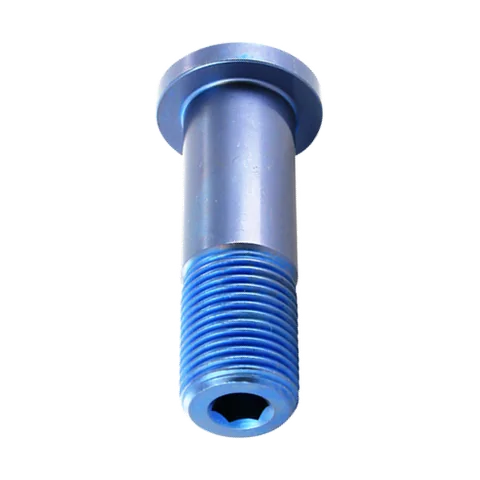
- Shear 85-95 ksi
- Access Two-sided
- Diameters 5/32 to 3/8"
- Materials Titanium, Alloy steel
- Lead-time risk Low
Two-sided, pin and collar (threaded): “Manually thread the collar onto the pin.” (Hi-Shear Hi-Lok and Hi-Lok/Hi-Tigue Installation Instructions, p.10, I.1 b)
- Shear
- 85-95 ksi
- Blind bulb
- n/a
- Install
- Both sides needed
- Diameters
- 5/32, 3/16, 1/4, 5/16, 3/8"
- Lead-time risk (SpecLok assessment)
- Low
Typical applications
- ·Pin-and-collar structural joints with two-side access
Strengths
- +"Collar wrenching device automatically shears off" (HL10 drawing)
- +Howmet: "eliminates the need for torque inspection"
Trade-offs
- −Needs access to both sides (pin and collar)
- −MIL-STD-889C: alloy steel is incompatible with graphite; titanium is compatible except in sea water
Also called HiLok, Hi Lok, pin and collar. P/N: HL10 / HL18 protruding shear head · HL11 / HL19 100° flush shear head · typical collars HL70, HL79, HL82, HL94, HL97
Datasheet strength: HL10: 6Al-4V titanium, 95,000 psi shear minimum; HL18: alloy steel, 95,000 psi shear (160,000-180,000 psi tensile): Hi-Shear drawings (Hi-Lok Product Specification 342).
Standards
- Hi-Lok Product Specification 342
- HL pin & collar standards (Hi-Shear)
Materials and galvanic compatibility vs CFRP
| Alloy | Shear | vs CFRP | Notes | Source |
|---|---|---|---|---|
| Titanium | 95 ksi | low | 6Al-4V (HL10 protruding / HL11 flush) | HL10 drawing: 6Al-4V per AMS4928/4967, 95,000 psi shear min |
| Alloy steel | 95 ksi | high | Alloy steel, 160-180 ksi tensile (HL18 / HL19) | HL18 drawing: 95,000 psi shear (160-180 ksi tensile) |
vs CFRP: MIL-STD-889C Table I, graphite column: high = incompatible in all environments; low = compatible except sea-water immersion; unrated = SpecLok has not read a rating for this material.About derived ksi
Specs source: Hi-Shear/LISI HL10 & HL18 pin drawings ↗: HL10 (Ti) sheet 1: sizes 1/8"-1", double shear & tension minimums; sheet 2: material, heat treat, part-number code. HL18 (alloy steel): same layout. Lead-time risk is SpecLok's sourcing assessment, not a datasheet value.
4 head styles
Some variants only partly sourcedNot redrawn: no head dimensions for this variant in the documents on file. The data at right is from the cited document.
Protruding shear head
- HL10: Titanium: 6Al-4V titanium alloy per AMS4928 or AMS4967, 95,000 psi shear minHi-Shear HL10 drawing, title block, sheet 2 ↗
- HL18: Alloy steel per AMS6415, AMS6349 or AMS6382, AMS6322; 95,000 psi shearHi-Shear HL18 drawing, title block ↗
Sizes and grip: First dash = nominal dia in 1/32nds; second dash = max grip in 1/16ths (HL10 sheet 2).
Pins verified from Hi-Shear drawing title blocks. Other HL pin numbers exist but are not decoded here.
Head styles (manufacturer terms)
- Protruding shear head (HL10, HL18)
- 100° flush shear head (HL11, HL19)
- Protruding tension head (HL12, HL20)
- 100° flush MS24694 tension head (HL21)
Pin and collar · 5 steps
1/5Pin inserted
“Insert the pin into the prepared non-interference fit hole.”
Hi-Shear Hi-Lok and Hi-Lok/Hi-Tigue Installation Instructions, p.10, I.1 a ↗
Drawing traced from: a.
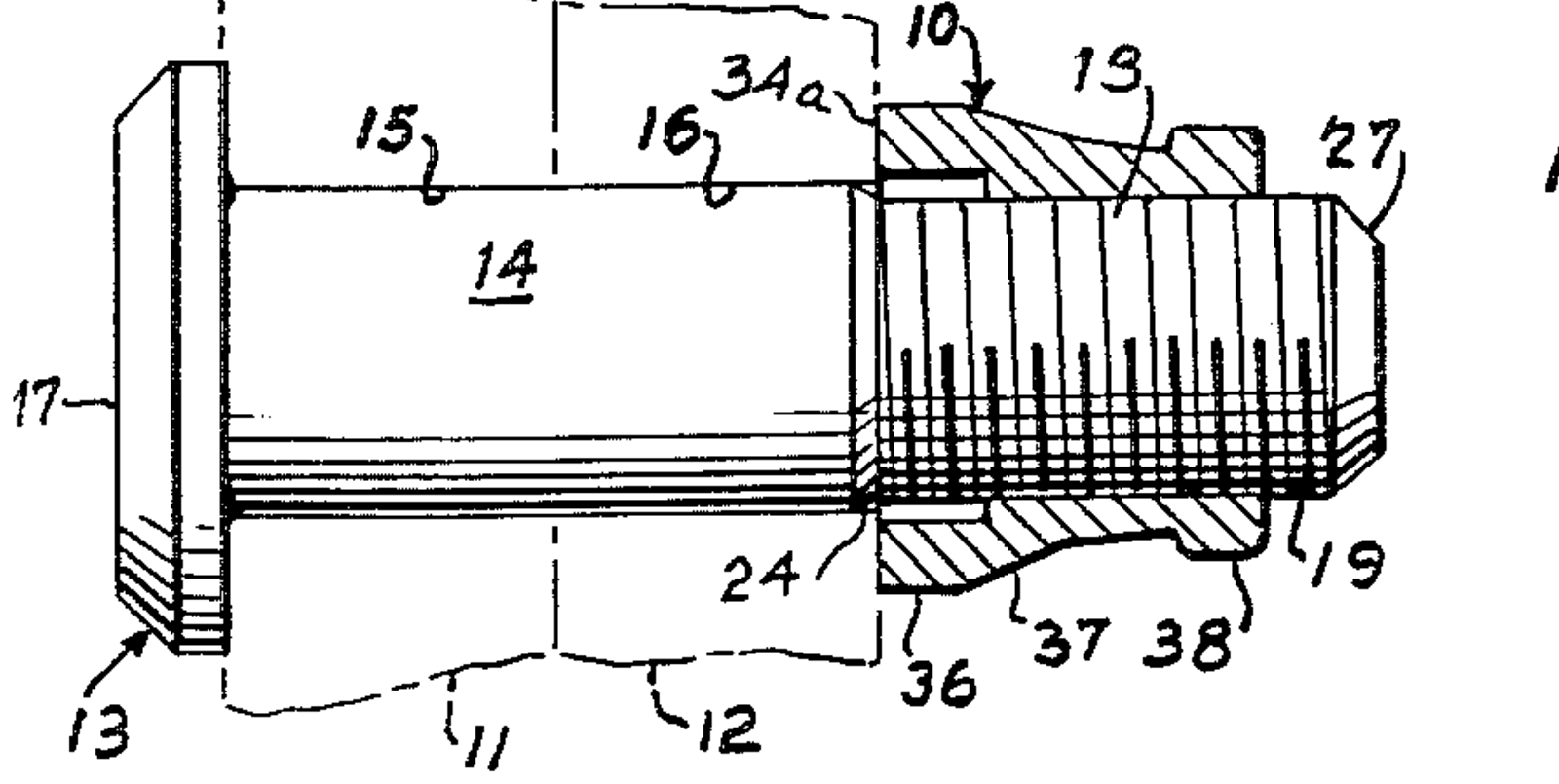
Source images (4): patent and government drawings
A patent drawing shows the patented design, which can differ in detail from today's catalog part. Each image says why it is tied to this family.
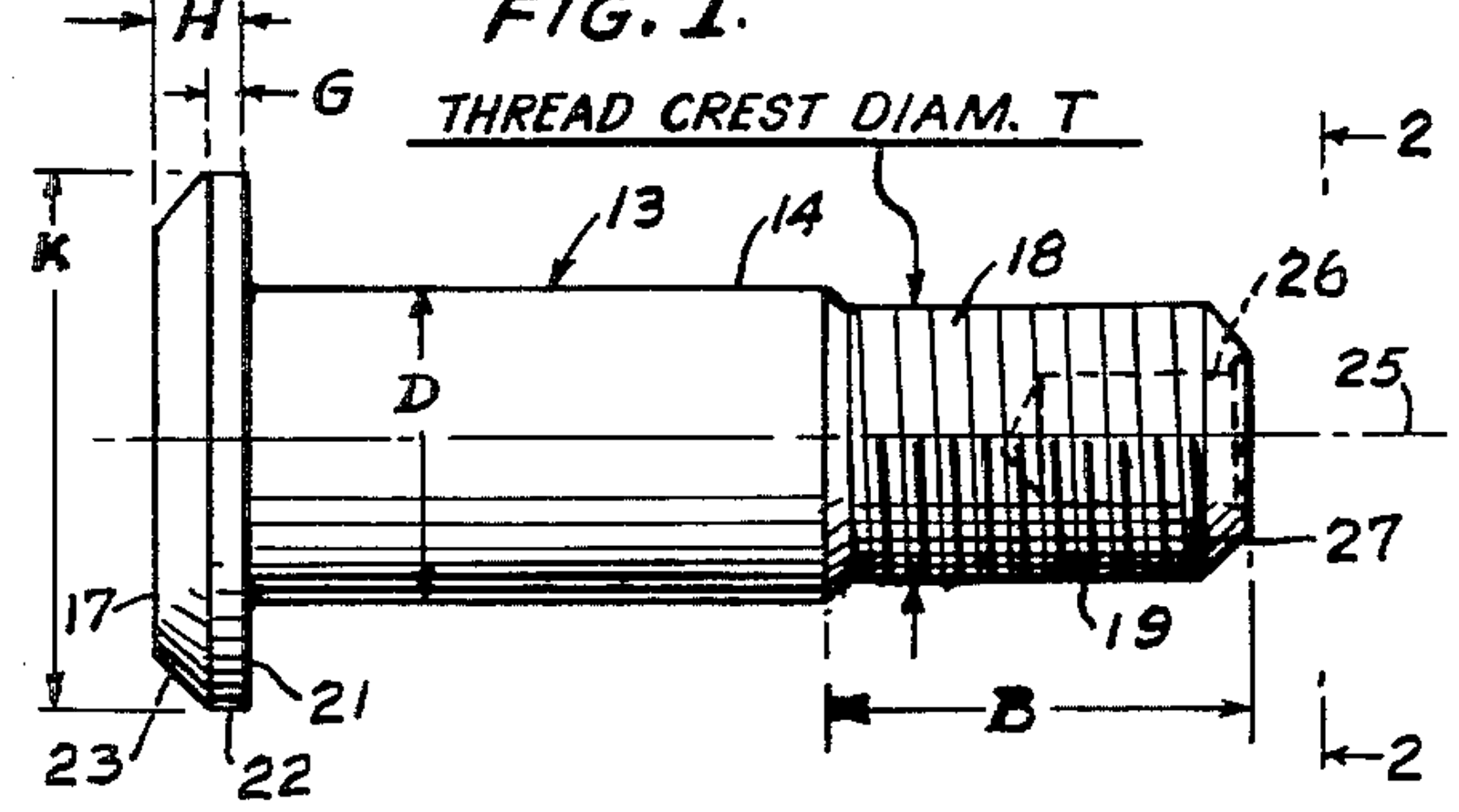
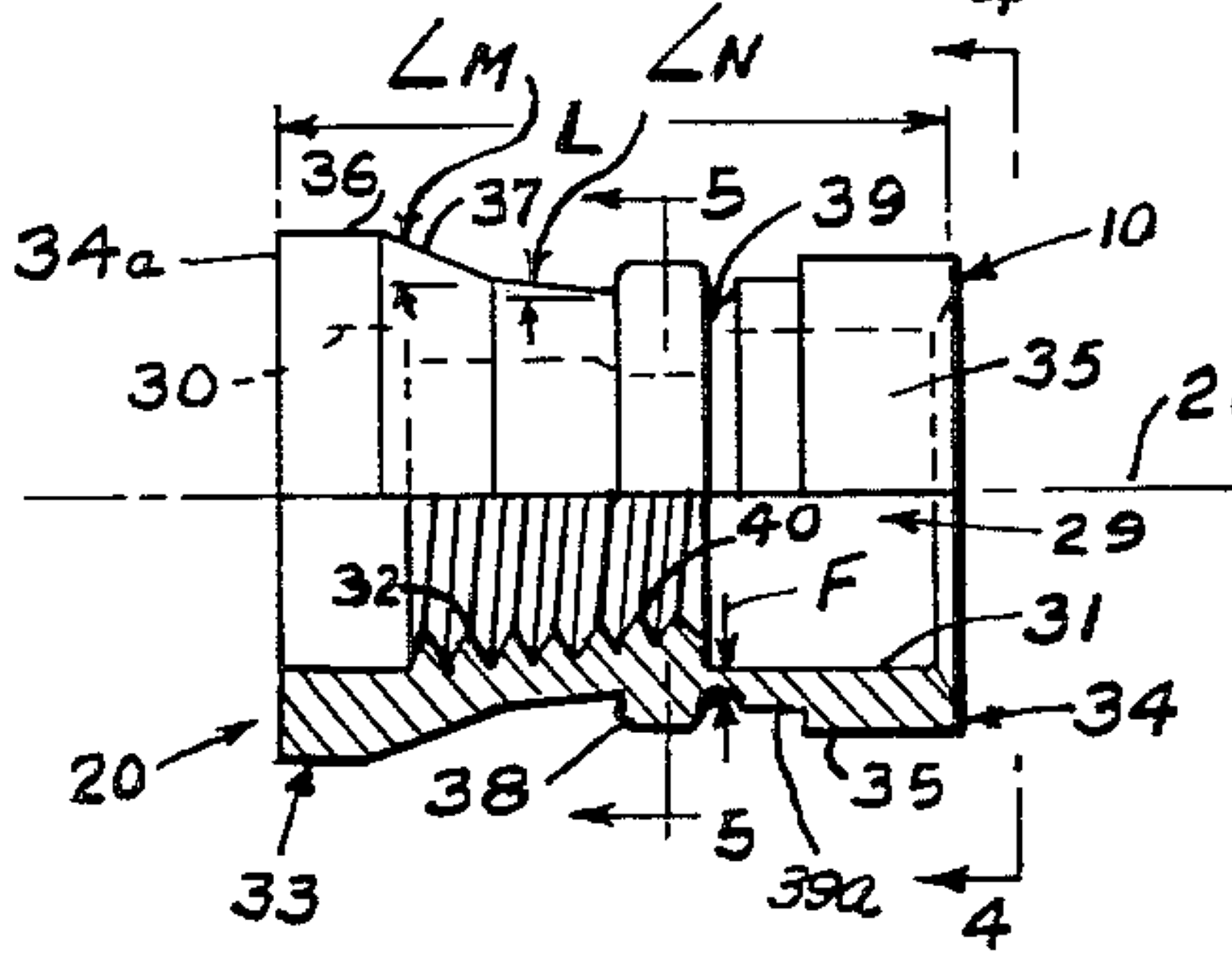
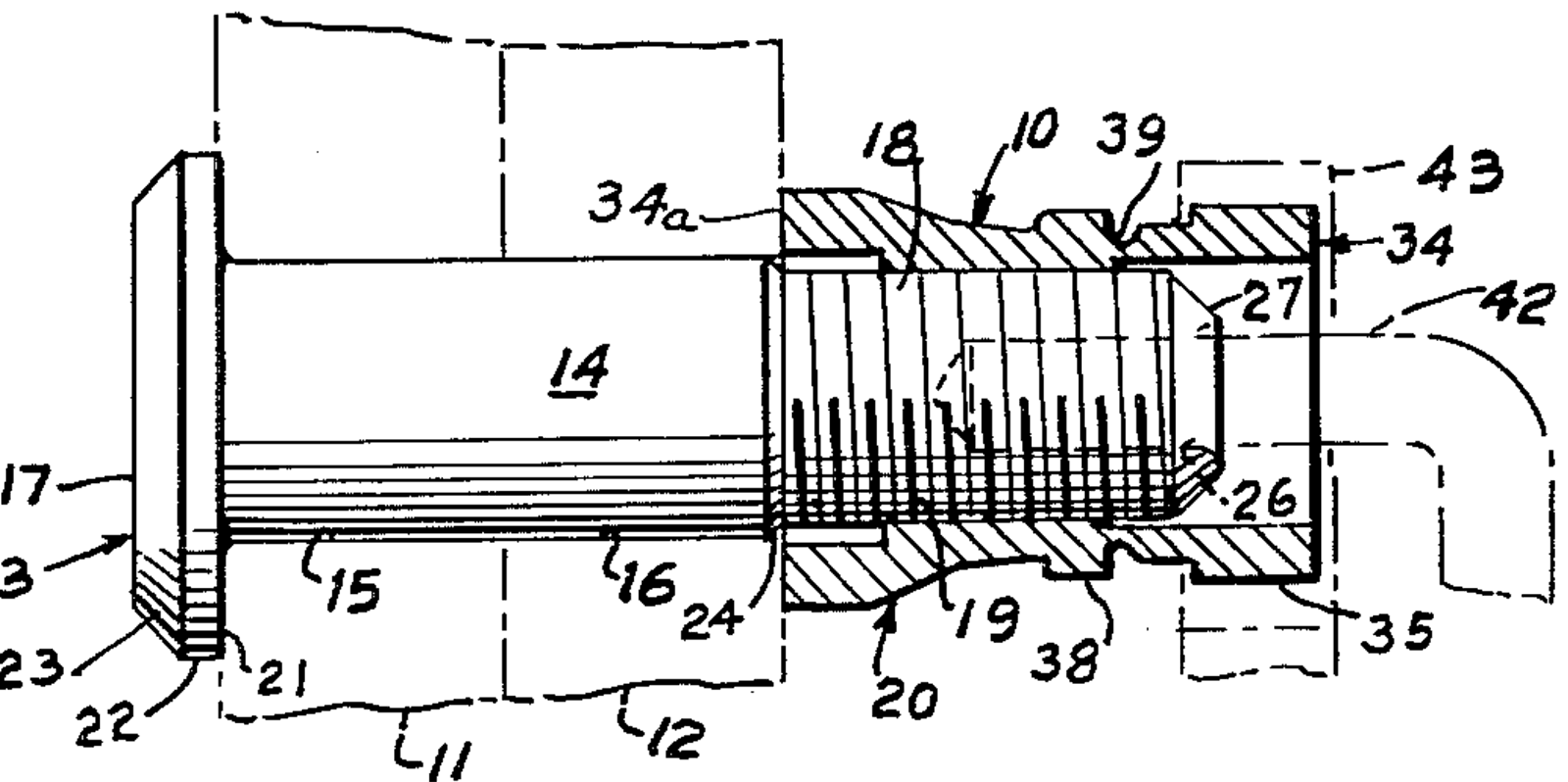
Official manufacturer install demonstration: Hi-Lok installation.
Installation verification and preload
Installed preload
Preload force is not published. What is published is the collar wrenching-hex torque-off range per size, the mechanism that sets preload: e.g. HL86 CRES tension collar -6: 40-50, -8: 110-130, -10: 200-250 (Hi-Shear collar standard sheets, Hi-Lok Product Specification 345). Howmet: the design "cannot be over-torqued... eliminates the need for torque inspection."
What to check after install
- The collar wrenching hex must have sheared off cleanly; the remaining collar portion is the installed configuration shown on the standard sheets.
- Pin protrusion and collar-seating gap limits are not published at the manufacturer level; quantitative limits live in the airframer's process spec or SRM.
Check gauges (1) and sources.Details
- None published by the manufacturer; torque inspection is designed out by the shear-off hex.
Sources: HL86 collar sheet · HL18 pin drawing · Howmet Hi-Lok system. Acceptance limits belong to the controlling spec; verify against your program's process documentation.
- Tool
- Hex key (holds the pin) and collar driver (Howmet Hi-Lok system)
- Special / proprietary
- Standard tooling
- Training
- Not stated in the cited documents.
- Inspection
- Collar wrenching hex sheared off (see verification below).
HL10 drawing, "after assembly" view: "Collar wrenching device automatically shears off". Howmet: the design "cannot be over-torqued" and "eliminates the need for torque inspection".
The published install tool and nose for each size, other access options, and the gauges that check the install, from the manufacturer's own tool tables.
| Dia. | Tool | Other access | Gauges |
|---|---|---|---|
| -5 | Not in the published table for this size | None published | None published |
| -6 | Not in the published table for this size | None published | None published |
| -8 | Not in the published table for this size | None published | None published |
| -10 | Not in the published table for this size | None published | None published |
| -12 | Not in the published table for this size | None published | None published |
Full tool tables, envelopes, clearances and source notesCompare tooling burden across all 25 families
Hi-Shear Hi-Lok Installation Instructions, K. Removal of Installed Fastener
- “In non-interference fit holes, Hi-Loks can be removed with common hand tools in a manner similar to removing a nut from a bolt. Use an Allen hex wrench to prevent the pin from rotating while the collar is being unscrewed with pliers. If not damaged during collar removal, the Hi-Lok pin can be reused.” Hi-Shear Hi-Lok and Hi-Lok/Hi-Tigue Installation Instructions, p.11, K.1 Common Tools ↗
- “To more easily remove Hi-Lok collars from pins installed in interference fit holes and in limited access areas, the HLH128 series of hand tools are available in individual sizes or in sets as in the HLK10 Hi-Lok/Hi-Tigue Collar Removal Tool Kit. The Hi-Lok pin can be reused.” Hi-Shear Hi-Lok and Hi-Lok/Hi-Tigue Installation Instructions, p.12, K.2 and K.3 ↗
- “In interference fit holes, ALUMINUM Hi-Lok/Hi-Tigue collars can be removed with an HLC1 Hi-Lok Collar Removal Tool fitted to a 3/8 square socket drive and companion air motor. The tool is pressed firmly over the Hi-Lok Collar and rotated until the tool teeth bite sufficiently into the collar material to grip and unscrew the collar from the pin.” Hi-Shear Hi-Lok and Hi-Lok/Hi-Tigue Installation Instructions, p.12, K.2 and K.3 ↗
- “Designed for production use to remove Hi-Lok collars from pins, pistol grip power drivers with cutter-type nosepieces are available. The Hi-Lok pin can be reused.” Hi-Shear Hi-Lok and Hi-Lok/Hi-Tigue Installation Instructions, p.13, K.4 Collar Removal Drivers ↗
Cautions
- “NOTE: Initial loosening of the -8 and larger Hi-Lok collars with the HLH128 Removal Tool is recommended.” Hi-Shear Hi-Lok and Hi-Lok/Hi-Tigue Installation Instructions, p.12, K.2 and K.3 ↗
None of the removal procedures on file gives a composite-specific removal caution. The Monogram specs address composite at the hole instead: holes "reasonably round and free from burrs (metallic structure) and delamination (graphite/epoxy type structure)" (MBF2003 §5.1).
HL10
Diameters 5/32", 3/16", 1/4", 5/16", 3/8" · 15 grip lengths
HL11
Diameters 5/32", 3/16", 1/4", 5/16", 3/8" · 15 grip lengths
HL18
Diameters 5/32", 3/16", 1/4", 5/16", 3/8" · 15 grip lengths
HL19
Diameters 5/32", 3/16", 1/4", 5/16", 3/8" · 15 grip lengths
- Manufacturer
- LISI
- Category
- Pin and collar
- Datasheet (PDF) ↗
- Manufacturer page ↗
- Hi-Shear/LISI HL10 & HL18 pin drawings ↗: HL10 (Ti) sheet 1: sizes 1/8"-1", double shear & tension minimums; sheet 2: material, heat treat, part-number code. HL18 (alloy steel): same layout.
Find the part number for your stack
Enter your stack thickness and diameter to get the HL10 dash number.
Dash numbers and grips: Hi-Shear HL10 drawing (Code note) ↗
Sourcing
Lead-time risk (SpecLok sourcing assessment): Low
Get quotes: SpecLok sources this from authorized distributors and returns price, lead time and certs.You buy from the authorized distributor, who is named on your returned quote. SpecLok is free for buyers.
Supply signalfor this family
- 10,235 NSNs carry a part number of this family, recorded by 317 CAGE codes (FLIS, March 2025).
- Last DoD award for PIN-RIVET items (FSC 5320): 2026-06-25; 2,535 awards since 2025-10-01.
- No SpecLok quotes yet.
A signal from records SpecLok holds, not availability, stock or a lead-time promise. FLIS lists who has recorded a part number for the item, not who makes it today. DoD awards carry no NSN or part number, so award activity is for the item name's class.
Sources: DLA FLIS Data Electronic Reading Room (PUB LOG) ↗, DLA PUB LOG ↗, USAspending.gov award search API ↗; DoD award data 2025-10-01 to 2026-07-06; compiled 2026-09-28.
Image credits: LISI AEROSPACE, HI-LOK™ and HI-LITE™ Fasteners product page, gallery ↗. Product images belong to their manufacturers.
Sources (11)
- Hi-Shear Hi-Lok and Hi-Lok/Hi-Tigue Installation Instructions
- Hi-Shear/LISI HL10 & HL18 pin drawings
- LISI product page
- Hi-Lok installation video
- Hi-Shear HL18 drawing
- Hi-Shear HL11 / HL19 drawing title blocks
- MIL-STD-889C Table I, graphite column: high = incompatible in all environments; low = compatible except sea-water immersion; unrated = SpecLok has not read a rating for this material.
- HL86 collar sheet
- DLA FLIS Data Electronic Reading Room (PUB LOG)
- DLA PUB LOG
- USAspending.gov award search API
Next · Find
Find your part number
Several zones or a variable bondline? The grip planner splits the buy across grips; then get it quoted.