Click Bond, adhesive-bonded fastener
Click Bond adhesive-bonded studs, standoffs and nutplates
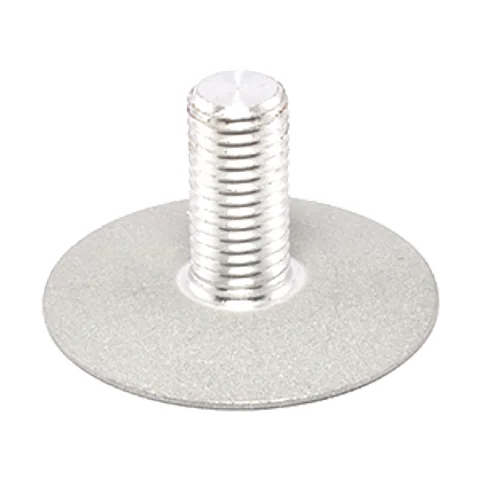
Bond a stud, standoff or nutplate to the surface: no rivet holes, and no hole at all for studs and standoffs.
- Shear No ksi rating (loads per datasheet)
- Access Bonded (no hole)
- Sizes Studs and standoffs: fine…
- Materials Aluminum, Stainless (CRES) +2
- Lead-time risk Medium
Bonded (no hole), adhesive-bonded fastener: “Click Bond’s bonded studs and standoffs provide the designer with new options for attachment of systems and modular components to structure, without drilling.” (Click Bond Product Guide, p.9, Studs & Standoffs)
- Shear
- No ksi rating (loads per datasheet)
- Blind bulb
- n/a
- Install
- One-side install
- Sizes
- Studs and standoffs: fine .1120-40 to .5000-20, coarse .190-24 to .750-10, MJ3 to M16; nutplates "from 04-40 to 1/2-20 and from M3 to M10" (Product Guide p.3, p.11)
- Lead-time risk (SpecLok assessment)
- Medium
Typical applications
- ·"Click Bond’s bonded studs and standoffs provide the designer with new options for attachment of systems and modular components to structure, without drilling." (Product Guide p.9)
- ·Nutplates: "simplify the closeout process for structural areas with no backside access, including attachment of removable skins and access panels" (Product Guide p.3)
Strengths
- +No hole for studs and standoffs: "Surface Mounts Go from one hole to none." (Click Bond Overview p.6)
- +"Click Bond adhesive-bonded nutplates are FAA TSO approved, allowing direct substitution for traditional riveted nutplates." (Product Guide p.2; TSO-C148 letters for CB6009, CB6010, CB6014, CB2009)
- +Nutplates: "All Click Bond nutplates conform to the performance requirements of NASM25027" (Product Guide p.2)
Trade-offs
- −No push-off, torque-out or tensile values for the aerospace studs, standoffs or nutplates are published in the free documents
- −Proprietary adhesive and fixture system; cure to handling strength from 15 minutes to 24 hours by adhesive (CBPS-206 Table IV)
- −Removal: CBPS-206 §2.9.1 says "Refer to CBPS-207", which is not published on clickbond.com
- −Nutplates still need the one fastener hole
Also called Click Bond, ClickBond, bonded stud, bonded standoff, adhesive bonded nutplate, rivetless nutplate, CB4000, CB4001, CB6009, TSO-C148. P/N: CB[basic][baseplate][thread][stud material][length]… · e.g. CB4001 G 3 CRA 12 H P 750 (Product Guide p.10) · nutplates e.g. CB6009 CR 3 CRS 1 P NL (p.4)
Datasheet strength: No push-off, torque-out or tensile values for the aerospace studs, standoffs or nutplates are published in the free documents. Nutplates: "All Click Bond nutplates conform to the performance requirements of NASM25027" (Product Guide p.2); CB6009 drawing: "NUTPLATE MEETS THE STRENGTH AND REUSABILITY REQUIREMENTS OF NASM25027." Adhesive CB200: shear 4400 psi (ASTM D1002), peel 21 pli (ASTM D1876), service -67°F to 250°F (Product Guide p.43).
Standards
- CBPS-206 (Click Bond process spec)
- TSO-C148 (CB6009, CB6010, CB6014, CB2009)
- NASM25027 (nutplate performance)
Materials and galvanic compatibility vs CFRP
| Alloy | Shear | vs CFRP | Notes | Source |
|---|---|---|---|---|
| Aluminum | n/a | high | Stud or standoff material "A = Aluminum", "AA = Anodized Aluminum". | Click Bond Product Guide p.11-12, Material Options |
| Stainless (CRES) | n/a | low | "CR, CRA, CRM = A-286/302/303/304/316 CRES Passivated". Nutplates: "Dome / baseplate are A-286 Stainless Steel" (CB6005 product page). | Click Bond Product Guide p.11-12, Material Options |
| Titanium | n/a | low | "T = Titanium" (stud or standoff). | Click Bond Product Guide p.11-12, Material Options |
| Non-metallic (composite or thermoplastic) | n/a | unrated | Baseplates: "C = Carbon/Epoxy, 350°F Cure", "G = Glass/Epoxy, 250°F Cure", "E = Glass/Epoxy, 350°F Cure", "K = Glass-Filled PEKK", "P = Glass-Filled PEEK", "U = 30% Glass-Filled PEI", "V = 40% Glass-Filled PEI", "UC = 30% Carbon-Filled PEI", "VC = 40% Carbon-Filled PEI". | Click Bond Product Guide p.11-12, Material Options |
vs CFRP: MIL-STD-889C Table I, graphite column: high = incompatible in all environments; low = compatible except sea-water immersion; unrated = SpecLok has not read a rating for this material.About derived ksi
Specs source: Click Bond Product Guide (studs, standoffs, nutplates, adhesives) ↗: Part number diagrams (p.4, p.10), part tables and material legend (p.11-13), adhesives (p.42-43). Printed page = PDF page minus 8. Lead-time risk is SpecLok's sourcing assessment, not a datasheet value.
5 head styles
Some variants only partly sourcedNot redrawn: no head dimensions for this variant in the documents on file. The data at right is from the cited document.
Stud, adhesive bonded
- CB3000: Stud A, AA, CR, CRA, CRM or T; baseplate per the part table
- CB3200: Stud A, AA, CR, CRA, CRM or T; baseplate per the part table
- CB4000: Stud A, AA, CR, CRA, CRM or T; baseplate per the part table
- CB4200: Stud A, AA, CR, CRA, CRM or T; baseplate per the part table
- CB5000: Stud A, AA, CR, CRA, CRM or T; baseplate per the part table
- CB9522: Stud A, AA, CR, CRA, CRM or T; baseplate per the part table
Sizes and grip: Baseplate R round or T trimmed, e.g. CB4000 R = 1.25" dia., T = .75" width; CB9522 R = 2.63" dia.
CB3000 drawing: "DISPOSABLE PRESSURE SENSITIVE ADHESIVE FIXTURE HOLDS STUD WHILE ADHESIVE CURES." (Click Bond drawing)
Per-product sales drawings on clickbond.com need registration, so bases are listed from the Product Guide tables; nutplate material and thread-relief codes are not decoded. Loads are not published in the free documents.
Head styles (manufacturer terms)
- Stud, adhesive bonded (CB3000, CB3200, CB4000, CB4200, CB5000, CB9522)
- Standoff, adhesive bonded (CB3001, CB3201, CB4001, CB4002, CB4201, CB4512, CB4516, CB5001)
- Nutplate, adhesive bonded (standard) (CB2009, CB2011, CB3009, CB3011, CB4009, CB4011, CB6003, CB6009, CB6011, CB6012, CB6013, CB6014, CB8009, CB8011, CB9197)
- Nutplate, adhesive bonded (sealed) (CB6008, CB6010, CB8008, CB8010, CB9356)
- Nutplate, adhesive bonded (sleeved) (CB6109, CB6209, CB6307, CB6309, CB6310, CB6311, CB6347, CB6349, CB6490, CB9382, CB9392, CB9530)
Adhesive-bonded · 4 steps
1/4Adhesive on the base
“Apply the mixed adhesive as a built-up spot to the center of the stud, standoff, or cable tie mount baseplate bonding area as indicated in Figure 5.”
Click Bond CBPS-206 Rev. 7 (adhesive bonding process spec), p.8, §2.6.1.3 ↗
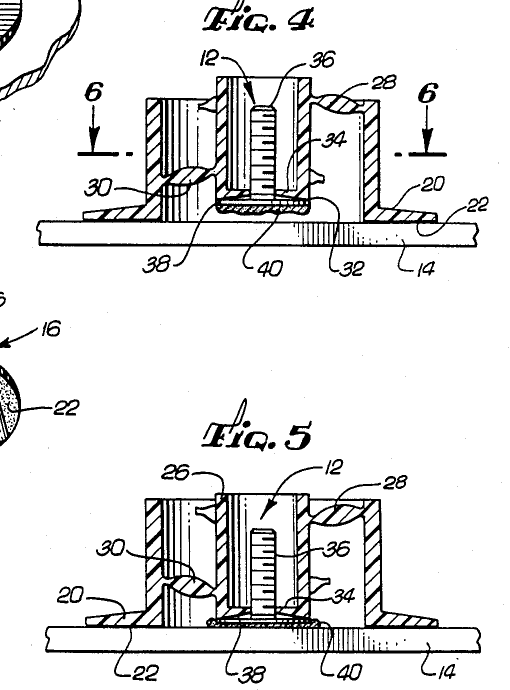
Drawing traced from: Fig. 4, the stud held clear of the substrate with adhesive on its base.
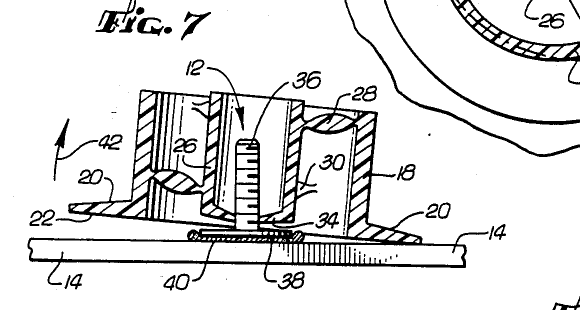
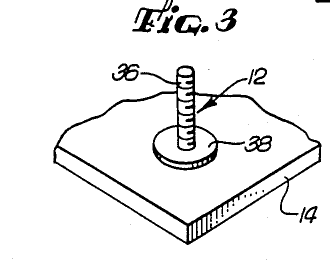
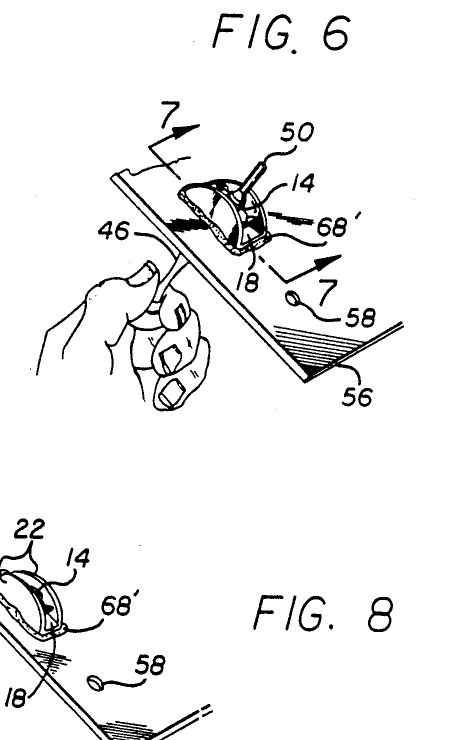
Source images (4): patent and government drawings
A patent drawing shows the patented design, which can differ in detail from today's catalog part. Each image says why it is tied to this family.
Installation verification and preload
Installed preload
Not applicable: a bonded fastener has no preload. No bond loads are published in the free documents.
What to check after install
- Surface prep: "Abrade composite materials with 120-180 grit aluminum oxide abrasive paper to remove surface gloss, mold release and resin high spots. CAUTION - Do not abrade into the fiber reinforcement." (CBPS-206 §2.4.2)
- Cure: handling strength ("CURE EXCEEDS 75% OF ULTIMATE STRENGTH") e.g. CB200-40 30 MINS, CB420-50E 15-18 MINS, CB394-43 24 HOURS; full cure CB200-40 24 HOURS, CB394-43 3-5 DAYS, at 75°F (CBPS-206 §2.7, Tables IV and V)
- "All exposed edges of bonded parts shall show a continuous adhesive bead squeeze out along the joined surfaces." (CBPS-206 §3.1.3)
- "Excess adhesive squeezed out of the joint shall be tested with a fingernail for cure. The adhesive shall feel tough and offer resistance to penetration and shall not be tacky." (CBPS-206 §3.1.4)
Check gauges (1) and sources.Details
- "Click Bond, Inc. offers proof load test tools for bonded fasteners" (CBPS-206 §3.1.5); no part numbers are given.
Sources: Click Bond CBPS-206 Rev. 7. Acceptance limits belong to the controlling spec; verify against your program's process documentation.
- Tool
- Click Bond adhesive and the disposable installation fixture (CBPS-206)
- Special / proprietary
- Special tooling · proprietary
- Training
- Not stated in the cited documents.
- Inspection
- "All exposed edges of bonded parts shall show a continuous adhesive bead squeeze out along the joined surfaces." (CBPS-206 §3.1.3); see verification below.
"Press down on the inner body of the fixture to actuate. Do not press on the protruding fastener. The over-center action of the fixture squeezes out the adhesive and holds the fastener in place while the adhesive cures." (CBPS-206 Rev. 7 §2.6.1.6). Nutplates: "Disposable installation fixtures are included with every nutplate." (Product Guide p.2)
The published install tool and nose for each size, other access options, and the gauges that check the install, from the manufacturer's own tool tables.
| Sizes | Published tool | Source |
|---|---|---|
| Click Bond adhesive and the disposable installation fixture (CBPS-206) | ||
Full tool tables, envelopes, clearances and source notesCompare tooling burden across all 25 families
Removal
No published removal procedure found; follow the manufacturer's instructions. Manufacturer page ↗
CB4000
15 sizes (thread, stud length)
- Manufacturer
- Click Bond
- Category
- Adhesive-bonded fastener
- Datasheet (PDF) ↗
- Manufacturer page ↗
- Click Bond Product Guide (studs, standoffs, nutplates, adhesives) ↗: Part number diagrams (p.4, p.10), part tables and material legend (p.11-13), adhesives (p.42-43). Printed page = PDF page minus 8.
Pick the part number
Sourcing
Lead-time risk (SpecLok sourcing assessment): Medium: Lead-time risk not yet assessed from sourcing data (default medium). Quoted by Click Bond part number.
Get quotes: SpecLok sources this from authorized distributors and returns price, lead time and certs.You buy from the authorized distributor, who is named on your returned quote. SpecLok is free for buyers.
Supply signalfor this family
- No FLIS records linked to this family yet.
- No SpecLok quotes yet.
A signal from records SpecLok holds, not availability, stock or a lead-time promise. FLIS lists who has recorded a part number for the item, not who makes it today. DoD awards carry no NSN or part number, so award activity is for the item name's class.
Sources: DLA FLIS Data Electronic Reading Room (PUB LOG) ↗, DLA PUB LOG ↗, USAspending.gov award search API ↗; DoD award data 2025-10-01 to 2026-07-06; compiled 2026-09-28.
Image credits: Click Bond, Inc., Adhesive Bonded Studs & Standoffs product page ↗ · Click Bond, Inc., Rivetless Nutplates product page ↗. Product images belong to their manufacturers.
Sources (12)
- Click Bond Product Guide
- Click Bond product page
- US 4,668,546 (Fixture for securing an adhesive attachment to a substrate)
- Click Bond CBPS-206 Rev. 7 (adhesive bonding process spec)
- MIL-STD-889C Table I, graphite column: high = incompatible in all environments; low = compatible except sea-water immersion; unrated = SpecLok has not read a rating for this material.
- DLA FLIS Data Electronic Reading Room (PUB LOG)
- DLA PUB LOG
- USAspending.gov award search API
- FAA TSO-C148 letter, CB6009
- Click Bond nutplates
- Click Bond Stud/Standoff Installation Instructions
- Click Bond Overview
Next · Find
Check Click Bond adhesive-bonded studs, standoffs and nutplates against your joint
Describe the joint in the selector to see how this family ranks, with the cited design rules.