generic-NAS, threaded insert
Threaded inserts (key-locked MS51830 / Keenserts, helical coil MS21209)
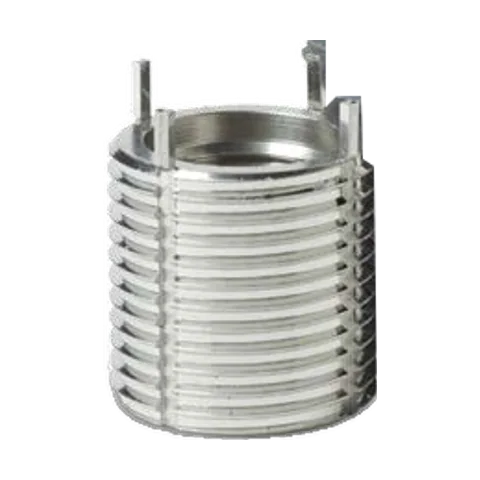
Durable threads in a tapped hole, installed from one side: key-locked (MS51830, Keensert) or helical coil (MS21209).
- Shear No ksi rating (loads per datasheet)
- Access Into a tapped hole
- Sizes Key-locked MS51830: intern…
- Materials Stainless (CRES), A286 CRES +1
- Lead-time risk Medium
Into a tapped hole, threaded insert: “This specification covers locked in, screw thread inserts which have integrated locking keys to prevent rotation of the insert when installed in the tapped holes.” (MIL-I-45914A (key-locked inserts), p.1, §1.1 Scope)
- Shear
- No ksi rating (loads per datasheet)
- Blind bulb
- n/a
- Install
- One-side install
- Sizes
- Key-locked MS51830: internal .086-56 to .500-13 UNJC-3B and .190-32 to .500-20 UNJF-3B. Helical coil: lengths "1, 1-1/2, 2, 2-1/2 and 3 times the nominal thread diameter" (MIL-I-8846D §6.3.2)
- Lead-time risk (SpecLok assessment)
- Medium
Typical applications
- ·"intended as a general purpose fastener with depth locating keys and a mechanical lock to resist rotation when installed" (key-locked, MIL-I-45914A §6.1)
- ·"intended for use in original design application, especially in soft materials, to provide protection against thread failures caused by stripping, fatigue, wear, corrosion, and seizing. They are also intended for use in the repair of damaged or worn threads not originally protected." (helical coil, MIL-I-8846D §6.1)
Strengths
- +Pullout and torque-out minimums tabulated per size for MS51830 inserts (MIL-I-45914A Tables III and VI)
- +Key-locked: "The pre-positioned keys automatically set the insert at the proper depth below the surface of the parent material." (Howmet, Installation, Removal & Broach p.1)
- +Key-locked removal: "An identical insert can now be installed in the original hole. No re-work of the hole will be necessary." (same, p.2)
Trade-offs
- −Howmet: "These inserts are not recommended for use in brittle materials, such as cast iron or plastic" (catalog p.2)
- −Helical coil: MS33537 is cancelled and "superseded by NASM33537" (Notice 1, 2002); NASM33537 and NASM8846 are not free and were not read
- −MS51835B note 5: "In materials harder than 150 Brinnell, key slots, broached prior to insert installation, may be required."
Also called Keensert, Keenserts, Keysert, key-locked insert, key locking insert, helical coil insert, Heli-Coil, screw thread insert, STI, MS51831, MS51832, MS33537, NASM33537, NASM21209, NAS1130. P/N: MS51830[-|CA|A][dash][L|LM] · e.g. MS51830CA106L (key-locked) · MS21209C0415 (helical coil, screw locking)
Datasheet strength: Key-locked MS51830, ultimate pullout load lbs (non-locked / internal thread lock part): .190 internal 4,095 / 2,551; .250: 6,401 / 4,660; .375: 11,607 / 9,088; .500: 19,364 / 15,743, where "Pullout load = (Shear engagement area) x (27,000 psi)" (MIL-I-45914A Table III, p.8). Torque out, inch-pounds, MS51830: .250 120; .500 600 (Table VI, p.11). Helical coil screw locking, .250-20: 30 max locking / 4.5 min breakaway, pound-inches at room temperature (MIL-I-8846D Table II, p.5).
Standards
- MS51830
- MS51835
- MIL-I-45914
- MS21209 (now NASM21209)
- MS33537 (now NASM33537)
- MIL-I-8846 (now NASM8846)
Materials and galvanic compatibility vs CFRP
| Alloy | Shear | vs CFRP | Notes | Source |
|---|---|---|---|---|
| Stainless (CRES) | n/a | low | Key-locked: "Steel, corrosion-resistant, Type 303 (UNS S30300) ... or Type 303SE (UNS S30323)"; dash = CRES. Keys: "steel, corrosion-resistant. Type 302". | MS51830F p.4, Requirement 1 and 7 |
| A286 CRES | n/a | low | Key-locked: "Type A286 (UNS S66286)", "heat treated to 140,000 psi Ftu minimum". Code CA. | MS51830F p.4, Requirements 1, 5 and 7 |
| Alloy steel | n/a | high | Key-locked: "grade 4140 (UNS G41400) ... or grade 8740 (UNS G87400)", "heat treated to 160,000 psi Ftu minimum", cadmium plated. Code A. | MS51830F p.4, Requirements 1, 2, 5 and 7 |
| Stainless (CRES) | n/a | low | Helical coil: wire per AS 7245 (chromium 17.00 to 20.00, nickel 8.00 to 10.50), "tensile strength not lower than 150,000 pounds per square inch (psi)". | MIL-I-8846D §3.2.1, §3.2.2 (p.4) |
vs CFRP: MIL-STD-889C Table I, graphite column: high = incompatible in all environments; low = compatible except sea-water immersion; unrated = SpecLok has not read a rating for this material.About derived ksi
Specs source: MS51830F w/Amendment 1 (Insert, screw-thread, locked in, key-locked, miniature and lightweight) ↗: Tables I and II (dash, internal and external thread, length); Requirements 1 to 9. Installation per MS51835B; pullout and torque-out per MIL-I-45914A. Lead-time risk is SpecLok's sourcing assessment, not a datasheet value.
5 head styles
Some variants only partly sourced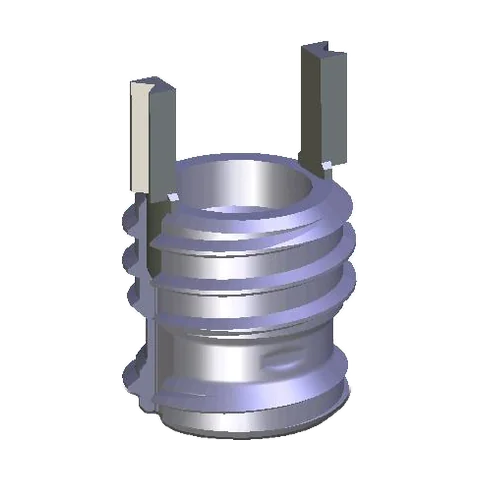
Not redrawn: no head dimensions for this variant in the documents on file. The data at right is from the cited document.
Key-locked insert, miniature and lightweight
- MS51830: Dash: CRES type 303 or 303SE; CA: CRES type A286; A: alloy steel 4140 or 8740. Keys CRES type 302.Dash 101 to 110 (UNJC-3B internal) and 201 to 206 (UNJF-3B internal), Tables I and II. Suffix L = internal thread lock, aerospace; LM = non-aerospace.
"Inserts with internal thread size .250 and smaller shall be supplied with two (2) locking keys spaced 180° apart. Inserts with internal thread size .3125 and greater shall be supplied with four (4) locking keys spaced 90° apart." (Requirement 9)
Source: MS51830F w/Amendment 1, p.2-4, Tables I and II, Requirements 1, 7, 9 ↗
MS51831 (heavy duty) and MS51832 (extra heavy duty) sheets were not read; they appear only in the MS51835B hole tables. The current helical coil documents (NASM21209, NASM33537, NASM8846, NAS1130) are not free. MS21209 thread-diameter codes are not decoded: the sheet scan is not legible enough to read the code table.
Head styles (manufacturer terms)
- Key-locked insert, miniature and lightweight (MS51830)
- Key-locked insert, heavy duty and extra heavy duty (MS51831, MS51832)
- Helical coil insert, screw locking (MS21209)
- Helical coil insert, free running (MS122076)
- Helical coil insert, tangless (NAS1130)
Threaded insert · 2 steps
1/2Hole prepared
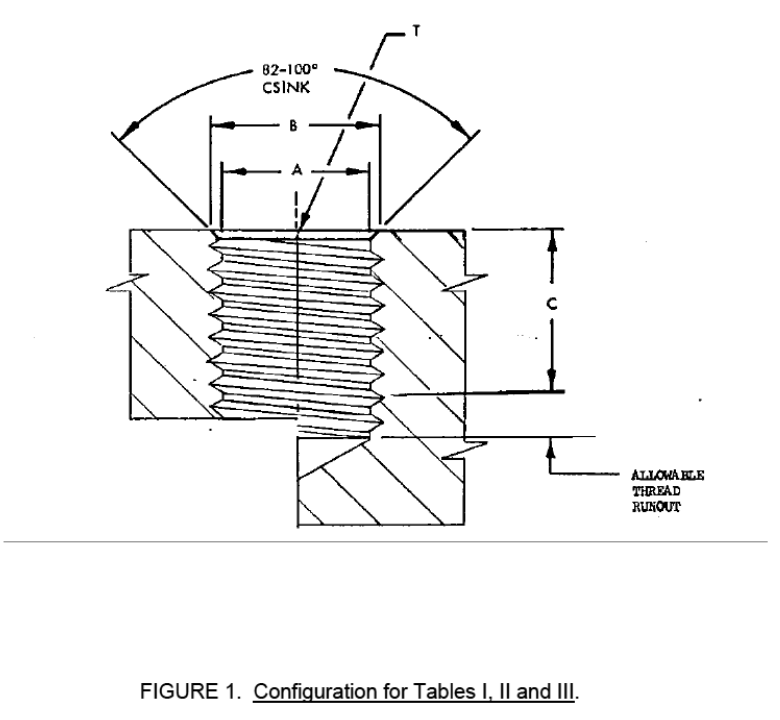
“Hole preparation in accordance with Tables I, II and III per applicable thread size of part and corresponding dash number.”
MS51835B (key-locked insert hole and assembly), p.5, Figure 2 requirements ↗
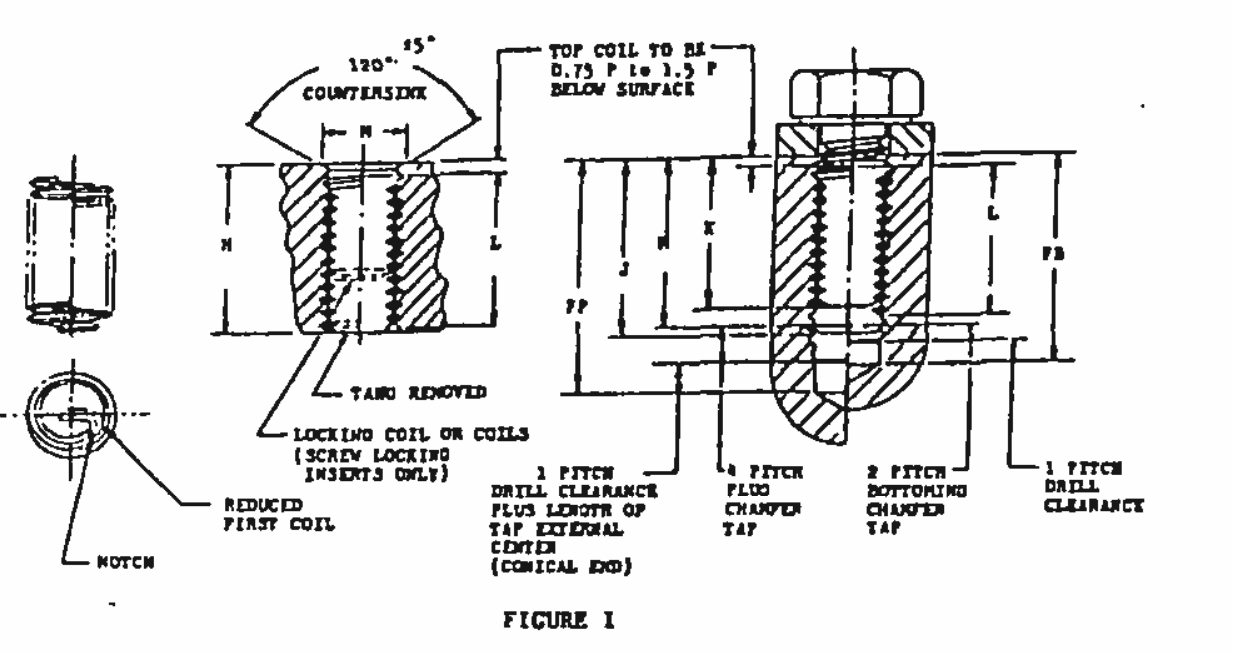
Drawing traced from: Figure 1, Configuration for Tables I, II and III.
Source images (3): patent and government drawings
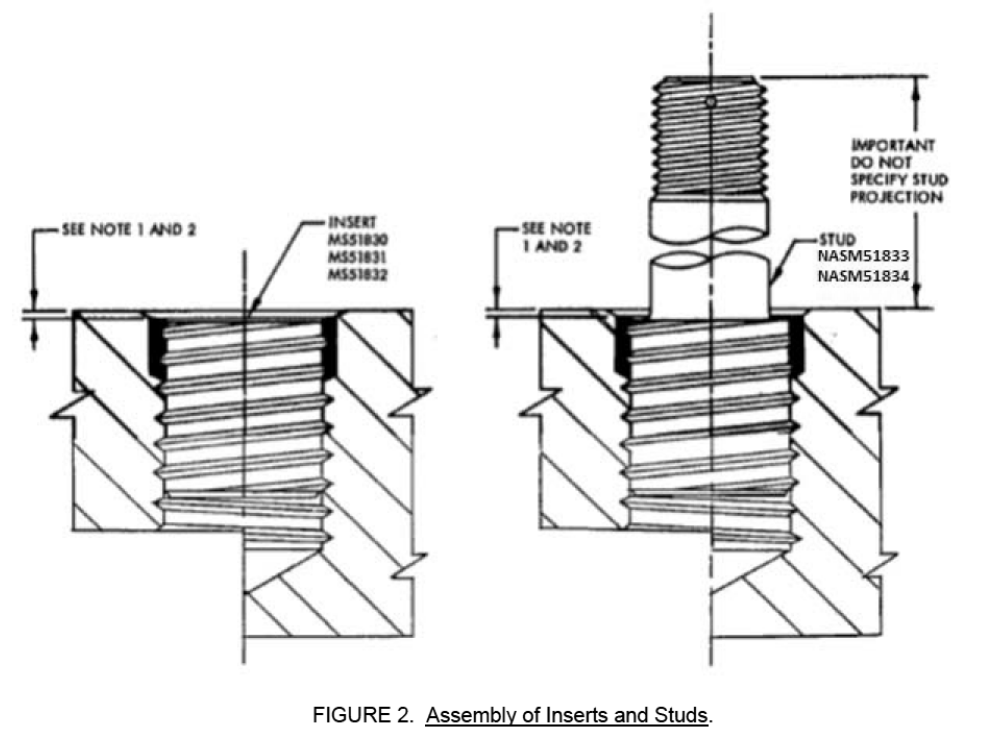
A patent drawing shows the patented design, which can differ in detail from today's catalog part. Each image says why it is tied to this family.
Installation verification and preload
Installed preload
Not applicable: inserts carry the screw's load into the parent material. MIL-I-45914A gives pullout and torque-out minimums (see datasheet strength); no preload is published.
What to check after install
- Key-locked hole: "Hole preparation in accordance with Tables I, II and III per applicable thread size of part and corresponding dash number." Example, MS51830-106 / -202 (.375-16): A .331-.336, CSINK B .385 (+.010 -.000), min full thread C .430 (MS51835B p.2, p.5).
- Key-locked: "Install insert or stud as shown. (Keys locate correct depth.)" then "Drive keys as shown." (MS51835B Figure 2 requirements, p.5)
- Helical coil, with countersunk hole: "The top edge of the insert shall be installed 0.75p to 1.5p below top surface of the tapped hole."; tang: "The tang should be removed from the insert after installation." (MS33537E sheet 2, 11.1 and 11.3)
- Helical coil: "If the finished tapped hole gages satisfactorily, the installed insert will be within the thread tolerance when the insert meets the MS drawing requirements. It is, therefore, not necessary to gage the installed insert." (MS33537E sheet 2, 13)
- Helical coil: "The minor diameter, countersink, and thread form of the holes shall be verified prior to installation of helical coil inserts. Post-process verification of insert depth and tang count (when tanged inserts are used) is required." (NASA PRC-9008 §8.0)
Check gauges (1) and sources.Details
- No insert gauge part number is named in the documents read; MS33537E checks the tapped hole, not the installed insert.
Sources: MS51835B · MS33537E · NASA PRC-9008 Rev E. Acceptance limits belong to the controlling spec; verify against your program's process documentation.
- Tool
- Key-locked: standard drill, countersink and tap, then the Keensert installation tool drives the keys. Helical coil: STI tap, inserting tool, tang break-off tool
- Special / proprietary
- Special tooling
- Training
- PRC-9008 §9.0: "This process shall be performed by personnel qualified through training or experience and certified by their supervision to conduct the process." (NASA JSC process spec, helical coil)
- Inspection
- See verification below: MS51835B hole limits; PRC-9008 §8.0 for helical coil.
Keensert: "1. Drill with a standard drill, as listed for each part number. 2. Countersink with a standard countersink (82° to 100°). 3. Tap with a standard Unified Thread Series tap. 4. Screw in insert with fingers or installation tool. ... 5. Using the installation tool, drive in the keys." (Howmet Keenserts Installation, Removal & Broach, p.1). Helical coil: "Holes for helical coil inserts are tapped with a special tap known as a Screw Thread Insert (STI) tap." (NASA PRC-9008 §3.1)
The published install tool and nose for each size, other access options, and the gauges that check the install, from the manufacturer's own tool tables.
Full tool tables, envelopes, clearances and source notesCompare tooling burden across all 25 families
Howmet Keenserts Installation, Removal & Broach, Insert Removal (key-locked)
- “Use standard drill, as listed for each part number to remove insert material between KEES.” Howmet Keenserts Installation, Removal & Broach, p.2, Insert Removal ↗
- “Deflect KEES inward and break off.” Howmet Keenserts Installation, Removal & Broach, p.2, Insert Removal ↗
- “Remove insert with E-Z OUT type tool.” Howmet Keenserts Installation, Removal & Broach, p.2, Insert Removal ↗
- “An identical insert can now be installed in the original hole. No re-work of the hole will be necessary.” Howmet Keenserts Installation, Removal & Broach, p.2, Insert Removal ↗
Removal drill size per insert (Howmet catalog p.11, Removal columns)
| MS51830 dash | Drill size |
|---|---|
| -101 | #33 (.113) |
| -102 | #29 (.136) |
| -103 | #21 (.159) |
| -104 | #8 (.199) |
| -105 / -201 | 7/32 |
| -106 / -202 | 9/32 |
| -107 / -203 | 11/32 |
| -108 / -204 | 13/32 |
| -109 / -205 | 15/32 |
| -110 / -206 | 17/32 |
Howmet Keysert and Keensert catalog, p.11, Removal, Drill Size ↗
Also published: NASA PRC-9008 Rev E §6.3 (helical coil)
- “The manufacturer's tooling shall be used to back out the discrepant helical insert.” NASA PRC-9008 Rev E (helical coil insert installation), p.8, §6.3 Removal or Replacement ↗
- “The hole shall be re-inspected per section 6.2 before a new helical insert is installed.” NASA PRC-9008 Rev E (helical coil insert installation), p.8, §6.3 Removal or Replacement ↗
Cautions
- “Helical inserts shall not be reinstalled.” NASA PRC-9008 Rev E (helical coil insert installation), p.8, §6.3 Removal or Replacement ↗
None of the removal procedures on file gives a composite-specific removal caution. The Monogram specs address composite at the hole instead: holes "reasonably round and free from burrs (metallic structure) and delamination (graphite/epoxy type structure)" (MBF2003 §5.1).
MS51830
32 sizes (internal / external thread, length l)
- Manufacturer
- generic-NAS
- Category
- Threaded insert
- Datasheet (PDF) ↗
- Manufacturer page ↗
- MS51830F w/Amendment 1 (Insert, screw-thread, locked in, key-locked, miniature and lightweight) ↗: Tables I and II (dash, internal and external thread, length); Requirements 1 to 9. Installation per MS51835B; pullout and torque-out per MIL-I-45914A.
Pick the part number
Sourcing
Lead-time risk (SpecLok sourcing assessment): Medium: Lead-time risk not yet assessed from sourcing data (default medium). Quoted by MS51830 and MS21209 part number.
Get quotes: SpecLok sources this from authorized distributors and returns price, lead time and certs.You buy from the authorized distributor, who is named on your returned quote. SpecLok is free for buyers.
Supply signalfor this family
- No FLIS records linked to this family yet.
- No SpecLok quotes yet.
A signal from records SpecLok holds, not availability, stock or a lead-time promise. FLIS lists who has recorded a part number for the item, not who makes it today. DoD awards carry no NSN or part number, so award activity is for the item name's class.
Sources: DLA FLIS Data Electronic Reading Room (PUB LOG) ↗, DLA PUB LOG ↗, USAspending.gov award search API ↗; DoD award data 2025-10-01 to 2026-07-06; compiled 2026-09-28.
Image credits: Howmet Aerospace, Keysert® and Keensert® catalog, p.1 ↗ · Howmet Aerospace, Keenserts® General Purpose Inserts (catalog.howmetfasteners.com) ↗. Product images belong to their manufacturers.
Sources (15)
- MIL-I-45914A (key-locked inserts)
- MS51830F w/Amendment 1 (Insert, screw-thread, locked in, key-locked, miniature and lightweight)
- generic-NAS product page
- MS51835B (key-locked insert hole and assembly)
- MS21209E
- MS33537E
- NASA PRC-9008 Rev E
- MIL-I-8846D §3.2.1, §3.2.2 (p.4)
- MIL-STD-889C Table I, graphite column: high = incompatible in all environments; low = compatible except sea-water immersion; unrated = SpecLok has not read a rating for this material.
- Howmet Keysert and Keensert catalog
- Howmet Keenserts Installation, Removal & Broach
- A-A-59158 (helical coil insert tools)
- DLA FLIS Data Electronic Reading Room (PUB LOG)
- DLA PUB LOG
- USAspending.gov award search API
Next · Find
Check Threaded inserts (key-locked MS51830 / Keenserts, helical coil MS21209) against your joint
Describe the joint in the selector to see how this family ranks, with the cited design rules.