generic-NAS, nutplate
Self-locking nutplates (MS21047, MS21059, MS21069, MS21078; rivetless ForceTec)
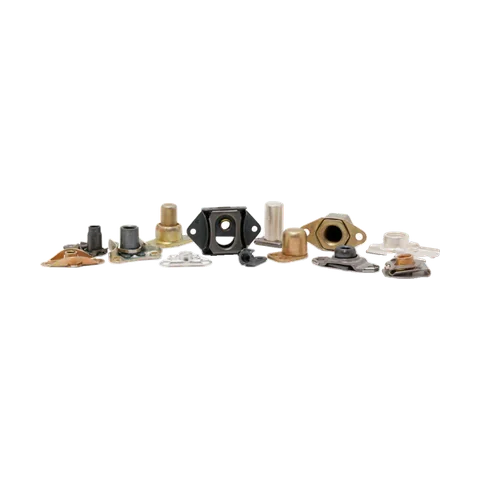
The captive nut behind a panel: MS/NASM self-locking plate nuts, riveted, plus the rivetless ForceTec.
- Shear No ksi rating (loads per datasheet)
- Access Two-sided
- Sizes .086-56 (MS21069 -02) and…
- Materials Carbon steel, Alloy steel +1
- Lead-time risk Medium
Two-sided, nutplate: “Self-locking nut plates are produced in a variety of forms and materials for riveting or welding to aircraft structures or parts.” (FAA AC 43.13-1B, p.7-11, par. 7-64g)
- Shear
- No ksi rating (loads per datasheet)
- Blind bulb
- n/a
- Install
- Both sides needed
- Sizes
- .086-56 (MS21069 -02) and .112-40 UNJC-3B to .625-18 UNJF-3B (MS21047F Table I)
- Lead-time risk (SpecLok assessment)
- Medium
Typical applications
- ·"The use of screws and nutplates in place of Hi-Loks® or blind fasteners is recommended if a panel must be removed periodically for maintenance." (FAA-H-8083-31B p.7-49)
- ·"Self-locking nut plates are produced in a variety of forms and materials for riveting or welding to aircraft structures or parts." (AC 43.13-1B par. 7-64g)
Strengths
- +Torque-out and push-out minimums per thread size (MIL-DTL-25027H Tables V and VI)
- +MS21047 axial strength tabulated per size, e.g. .190-32: 2,460 lbs min (MS21047F Table I)
- +ForceTec: "The ForceTec design meets NASM-25027 torque and pushout requirements without rivets or adhesive" (FTI brochure p.4)
Trade-offs
- −Riveted nutplates need access behind the structure to install; the screw then goes in from the front
- −MS33588 req. 1d: self-locking nuts shall not be used "WITH BOLTS, SCREWS, OR STUDS TO ATTACH ACCESS PANELS, DOORS OR TO ASSEMBLE ANY PARTS THAT ARE ROUTINELY DISASSEMBLED PRIOR TO OR AFTER EACH FLIGHT FOR ACCESS OR SERVICING."
- −"Nutplates used in composite structures usually require three holes: two for attachment of the nutplate and one for the removable screw" (FAA-H-8083-31B p.7-49)
- −The MS sheets are cancelled for the NASM equivalents (same part numbers); NASM sheets, NAS1068 and NASM25027 are not free and were not read
Also called nut plate, plate nut, anchor nut, nutplate, NASM21047, NASM21059, NAS1068, ForceTec, rivetless nutplate, MS21048, MS21051. P/N: MS21047[-|L][dash][K] · e.g. MS21047L4K (.250-28, dry film lubricant, countersunk or dimpled rivet holes) · NASM21047 same PIN
Datasheet strength: MIL-DTL-25027H Table V torque out, in-lb min: .112 20, .138 30, .164 45, .190 60, .250 100, .312 160, .375 240; Table VI push out, lb: .112 40, .138 60, .164 80, .190 100, ".250 and over" 125; Table III max locking / min breakaway, in-lb: .190-32 18 / 2.0, .250-28 30 / 3.5 (p.22-23). MS21047F Table I axial strength, lbs min: .190-32 2,460; .3125-24 7,390; .375-24 11,450. MS21047 "NUTS ARE DESIGNED TO DEVELOP THE TENSILE STRENGTH OF BOLTS AND SCREWS WITH AN ULTIMATE TENSILE STRENGTH OF 125 KSI" (Note 4).
Standards
- MS21047 (now NASM21047)
- MS21059 (now NASM21059)
- MS21069
- MS21078
- MS33588 (usage limits)
- MIL-DTL-25027 (now NASM25027)
- NAS1068
Materials and galvanic compatibility vs CFRP
| Alloy | Shear | vs CFRP | Notes | Source |
|---|---|---|---|---|
| Carbon steel | n/a | high | MS21047: "CARBON STEEL, COMPOSITIONS 1035 (UNS G10350) 1040 (UNS G10400) 1050 (UNS G10500) ... COMPOSITION 1042"; "CADMIUM PLATE IN ACCORDANCE WITH QQ-P-416 TYPE II, CLASS 2". 125 KSI Ftu, 450°F (title). | MS21047F p.2, Requirements 1 and 2; title block |
| Alloy steel | n/a | high | MS21047: "ALLOY STEEL, GRADES 4130 (UNS G41300) 4340 (UNS G43400) AND 8740 (UNS G87400)"; cadmium plated. | MS21047F p.2, Requirement 1 |
| A286 CRES | n/a | low | MS21048: "CORROSION RESISTANT STEEL, TYPE A286, (UNS S66286)"; 450° and 800°F (title); "ONLY 800°F NUTS SILVER PLATE ALL THREADED SURFACES OF NUT ELEMENT". | MS21048F p.2, Requirements 1 and 2; title block |
vs CFRP: MIL-STD-889C Table I, graphite column: high = incompatible in all environments; low = compatible except sea-water immersion; unrated = SpecLok has not read a rating for this material.About derived ksi
Specs source: MS21047F (Nut, self-locking, plate, two-lug, low height, steel, 125 KSI Ftu, 450°F) ↗: Table I (dash, thread, rivet hole øK and spacing J, axial strength), Requirements 1 to 10, Notes 4 and 5. Lead-time risk is SpecLok's sourcing assessment, not a datasheet value.
8 head styles
Some variants only partly sourcedNot redrawn: no head dimensions for this variant in the documents on file. The data at right is from the cited document.
NUT, SELF-LOCKING, PLATE, TWO-LUG, LOW HEIGHT, STEEL, 125 KSI Ftu, 450°F
- MS21047: Carbon or alloy steel, cadmium platedDash -04, -06, -08, -3, -4, -5, -6, -7, -8, -9, -10; countersunk or dimpled rivet holes (K) at -04K, -06K, -08K, -3K, -4K, -5KMS21047F (1 Feb 94) "is hereby canceled and superseded by NASM21047. The Part Identification Number (PIN) for MS21047F and the part number for NASM21047 are identical." (Notice 1, 9 Sep 1999)
MS21071, MS21075 and MS21076 were downloaded but not transcribed; MS21048's dash table was not transcribed. NAS1068 and NAS1033 are AIA documents and were not read (titles only, from AC 43.13-1B Table 7-13). ForceTec part numbers and sizes are behind FTI's technical library login.
Head styles (manufacturer terms)
- NUT, SELF-LOCKING, PLATE, TWO-LUG, LOW HEIGHT, STEEL, 125 KSI Ftu, 450°F (MS21047)
- NUT, SELF-LOCKING, PLATE, TWO LUG, LOW HEIGHT, CRES, 125 KSI Ftu, 450° AND 800°F (MS21048)
- NUT, SELF-LOCKING PLATE, ONE LUG LOW HEIGHT, STEEL, 125 KSI Ftu 450°F (MS21051)
- NUT, SELF-LOCKING, PLATE, TWO LUG, FLOATING, LOW HEIGHT STEEL, 125 KSI Ftu, 450° F (MS21059)
- NUT, SELF-LOCKING PLATE, TWO-LUG, REDUCED RIVET SPACING, LOW HEIGHT, STEEL, 125 KSI Ftu, 450°F (MS21069)
- NUT, SELF-LOCKING, PLATE, TWO LUG, NON-METALLIC INSERT, STEEL, 125 KSI Ftu, 250°F (MS21078)
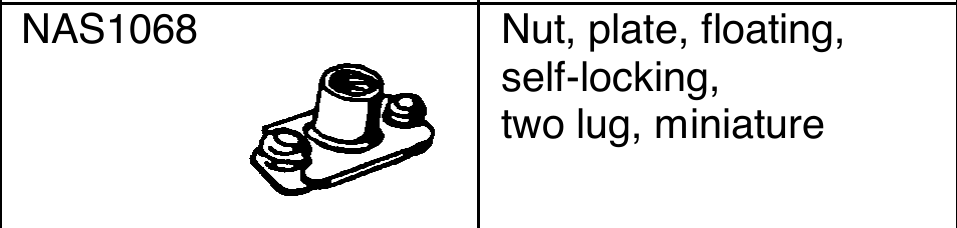
- Nut, plate, floating, self-locking, two lug, miniature (NAS1068)
- Rivetless nut plate, radially expanded retainer
No install diagram: no public-domain figure of a nutplate being installed was found. The FAA handbook's nutplate figures credit Cherry Aerospace and other contributors, and no FTI document names the ForceTec patent. The MS21047 drawing and AC 43.13-1B part views are under source images.
ForceTec (rivetless) install steps, in FTI's words (not drawn). No riveted-nutplate install procedure was found in the documents read.
- “Slide the split sleeve onto the mandrel” FTI ForceTec brochure, p.4, ForceTec Installation Procedure ↗
- “Insert the retainer into the starting hole from either side” FTI ForceTec brochure, p.4, ForceTec Installation Procedure ↗
- “Insert the mandrel/sleeve assembly through the retainer” FTI ForceTec brochure, p.4, ForceTec Installation Procedure ↗
- “Activate the hydraulic puller unit” FTI ForceTec brochure, p.4, ForceTec Installation Procedure ↗
- “Retract the mandrel all the way through the sleeve and retainer” FTI ForceTec brochure, p.4, ForceTec Installation Procedure ↗
- “Remove the split sleeve and insert the nut element” FTI ForceTec brochure, p.4, ForceTec Installation Procedure ↗
Source images (4): patent and government drawings
A patent drawing shows the patented design, which can differ in detail from today's catalog part. Each image says why it is tied to this family.
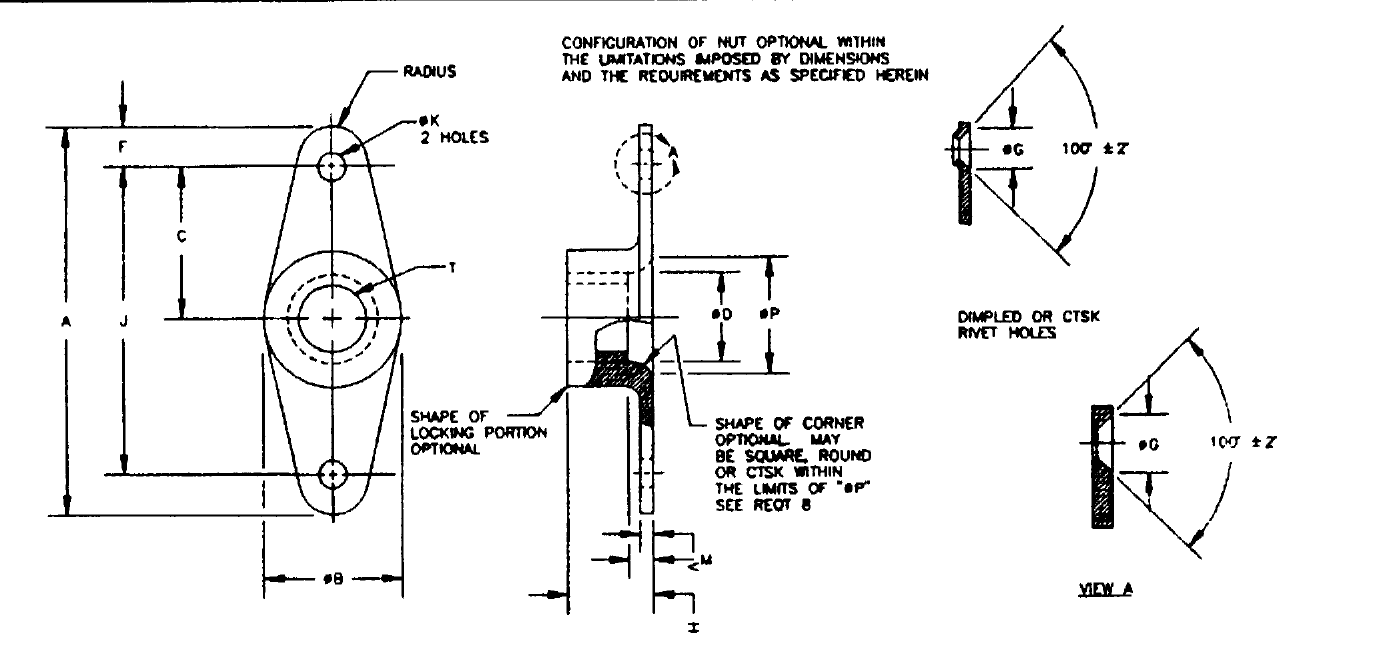
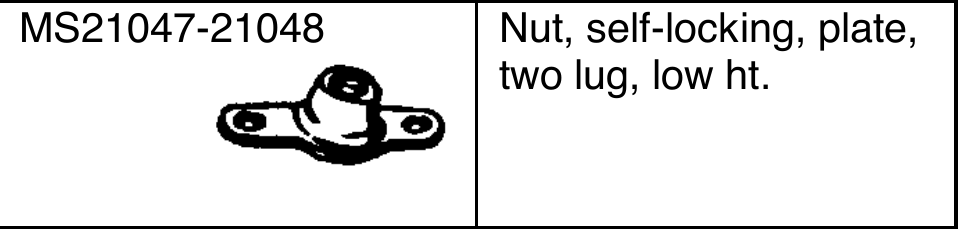
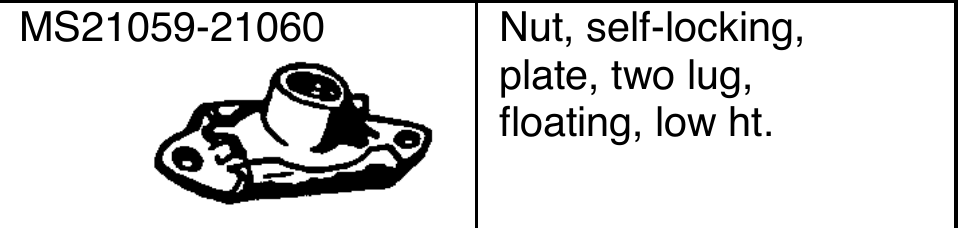
Installation verification and preload
Installed preload
Not published for the nutplate. MIL-DTL-25027H sets locking, breakaway, torque-out and push-out values for the nut (see datasheet strength).
What to check after install
- "BOLTS, STUDS OR SCREWS MUST EXTEND THRU THE SELF-LOCKING NUT FOR A MINIMUM LENGTH EQUIVALENT TO TWO THREADED PITCHES. THIS LENGTH INCLUDES THE CHAMFER." (MS33588E req. 2)
- "SELF-LOCKING PLATE NUTS SHALL BE ATTACHED TO THE STRUCTURE IN A POSITIVE MANNER ... THE MANNER OF ATTACHMENT SHALL PERMIT REMOVAL WITHOUT DAMAGE TO THE STRUCTURE AND PERMIT REPLACEMENT OF THE NUTS." (MS33588E req. 3)
- Rivet holes: MS21047F Table I gives øK (+.005 -.000) .098 at -04 to -4, .130 at -5 and -6, .161 at -7 to -10; "DIMPLED RIVET HOLE TOLERANCE FOR øK IS +.015 -.000" (footnote 3/); countersink or dimple 100° ±2°.
- "In the case of plate nuts, if proper bolt grip length is not available, add shims under the plate." (AC 43.13-1B par. 7-37)
Check gauges (1) and sources.Details
- MIL-DTL-25027H Figure 3 plate nut functional alignment gage (rivet-bolt hole spacing; a test-method gage).
Sources: MS33588E · MS21047F · MIL-DTL-25027H · FAA AC 43.13-1B par. 7-37. Acceptance limits belong to the controlling spec; verify against your program's process documentation.
- Tool
- Riveted: nutplate drill (two holes at once) and rivets per the design; rivetless ForceTec: FTI mandrel, split sleeve and puller
- Special / proprietary
- Standard tooling
- Training
- Not stated in the cited documents.
- Inspection
- MS33588 limits and MIL-DTL-25027H test values (see verification below).
"Special drill motors that drill two holes at the same time are used for the installation of nutplates. By drilling two holes at the same time, the distance between the holes is fixed and the holes line up perfectly with the holes in the nutplate." (FAA-H-8083-31B p.4-15). The MS sheets size the rivet holes (øK) and spacing (J) but name no rivet. ForceTec: "ForceTec is installed into the structure by radially expanding the nut plate retainer barrel into the hole creating a high interference fit between the barrel and the structure." (FTI brochure p.2)
The published install tool and nose for each size, other access options, and the gauges that check the install, from the manufacturer's own tool tables.
| Sizes | Published tool | Source |
|---|---|---|
| Riveted: nutplate drill (two holes at once) and rivets per the design; rivetless ForceTec: FTI mandrel, split sleeve and puller | ||
Full tool tables, envelopes, clearances and source notesCompare tooling burden across all 25 families
Removal
No published removal procedure found; follow the manufacturer's instructions. Manufacturer page ↗
MS21047
17 sizes (thread size, rivet holes)
MS21059
15 sizes (thread size, rivet holes)
- Manufacturer
- generic-NAS
- Category
- Nutplate
- Datasheet (PDF) ↗
- Manufacturer page ↗
- MS21047F (Nut, self-locking, plate, two-lug, low height, steel, 125 KSI Ftu, 450°F) ↗: Table I (dash, thread, rivet hole øK and spacing J, axial strength), Requirements 1 to 10, Notes 4 and 5.
Pick the part number
Sourcing
Lead-time risk (SpecLok sourcing assessment): Medium: Lead-time risk not yet assessed from sourcing data (default medium). Quoted by MS21047 and NAS1068 part number.
Get quotes: SpecLok sources this from authorized distributors and returns price, lead time and certs.You buy from the authorized distributor, who is named on your returned quote. SpecLok is free for buyers.
Supply signalfor this family
- No FLIS records linked to this family yet.
- No SpecLok quotes yet.
A signal from records SpecLok holds, not availability, stock or a lead-time promise. FLIS lists who has recorded a part number for the item, not who makes it today. DoD awards carry no NSN or part number, so award activity is for the item name's class.
Sources: DLA FLIS Data Electronic Reading Room (PUB LOG) ↗, DLA PUB LOG ↗, USAspending.gov award search API ↗; DoD award data 2025-10-01 to 2026-07-06; compiled 2026-09-28.
Image credits: PCC Fasteners, Anchor Nuts product page ↗ · Fatigue Technology (FTI), ForceTec® Rivetless Nut Plate brochure, p.5 ↗. Product images belong to their manufacturers.
Sources (17)
- FAA AC 43.13-1B
- MS21047F (Nut, self-locking, plate, two-lug, low height, steel, 125 KSI Ftu, 450°F)
- generic-NAS product page
- MS21048 (title block, Table I)
- MS21051 (title block, Table I)
- MS21059 (title block, Table I)
- MS21069 (title block, Table I)
- MS21078 (title block, Table I)
- FTI ForceTec brochure
- MIL-STD-889C Table I, graphite column: high = incompatible in all environments; low = compatible except sea-water immersion; unrated = SpecLok has not read a rating for this material.
- MS33588E
- MIL-DTL-25027H
- FAA-H-8083-31B (AMT Handbook, Airframe)
- DLA FLIS Data Electronic Reading Room (PUB LOG)
- DLA PUB LOG
- USAspending.gov award search API
- MS21047F Notice 1 (superseded by NASM21047)
Next · Find
Check Self-locking nutplates (MS21047, MS21059, MS21069, MS21078; rivetless ForceTec) against your joint
Describe the joint in the selector to see how this family ranks, with the cited design rules.